Friday, January 20, 2012

Film Review: Carnage

With obvious comparisons to Who's Afraid of Virginia Woolf? (though with more sobriety amongst the characters), this play turned movie, featuring just four characters and set inside one Brooklyn apartment, is a concise, acerbic, beast of a movie.  Starring Jodie Foster and John C. Reilly as a couple whose son is beaten up by another boy, and Kate Winslet and Christoph Waltz as the parents of the alleged offender, director Roman Polanski gives his actors just enough room (literally and figuratively) to do their interweaving diatribes of ferocity toward one another, but not enough room to be able to escape the vitriolic barbs of their close-quartered enemies.  Sharply written and sharply acted, especially by Winslet and Waltz, Carnage, based on the play Le Dieu du carnage by Yasmina Reza, is a verbally caustic, attack-ready take on the ideas of societal civility and just how far one will go to either keep the facade up or viciously tear it down - and each character has his or her turn at both sides of the gun

At a very brisk 79 minutes (shot in real time), Polanski never lingers on anything for too long, his subtly constantly moving camera doing physically what his characters do emotionally, but as the niceties of the early scenes devolve into the vicious realities of each character's own psyches (Waltz is the one character that never really tries to hold back his barbarism) the film becomes more and more harrowing and the viewer more and more apprehensive about what will come next, or more aptly, who will come apart next.  The characters begin to unravel - Winslet's indifference turning to open anger, Reilly's affable nature taken over by his inability to have control, Foster's faux liberalism taken to the breaking point of absurdity, Waltz's pomposity beaten down by the loss of his cell phone life line (we see his arrogance curled up on the floor like a reprimanded child) - and with each successive scene they fall apart more and more.  With each passing moment they act worse and worse toward each other - far more childish than either of their children had acted in the first place.

Granted, the film never goes much deeper than a few figurative skin abrasions, and the barbed verbal attacks are nothing when compared to the monstrous goings-on in the aforementioned Virginia Woolf (the added tension of Taylor and Burton's real life relationship added to that as well) but nonetheless, Polanski gets some great, if not exactly powerful (all four have been harder hitting in other roles) performances out of his claustrophobic quartet, and the acid-tongued breaking down of civility is great fun to watch.  Perhaps this is just this critic's own rather warped sense of societal rules.  One could even say it is a giddy treat to see these four supposedly civilized people go from decorum to destruction in less than 79 minutes.  I just wished there had been more - if not more time, at least more viciousness.  Then again, perhaps that is just me.  But really, it is quite fun to watch.

Anomalous Material Weekly Feature: 10 Most Heinous Oscar Snubs

Here we are again true believers, with my latest weekly 10 best feature for the fine folks over at Anomalous Material.  For those of you not in the know, those same said fine folks have given me a (possibly foolish on their behalf) regular gig as feature writer.  It is a series of top ten lists on various cinematic subjects - and anyone who knows me can attest to how perfectly suited I am to such an endeavor (yes I am a  list nerd).  This week's feature, my twenty-first such feature, is all about the Oscars.  The worst of the Oscars.  With the Oscar nominations being announced this coming week, I thought I would take a look at the most unworthy Oscar winners in the award's history.  The worst of the worst.  It took a lot of whittling down since the Oscars are well known for some pretty bad atrocities of taste, but here they are - just one click away.


This list is so full of horrendous Oscar blunders, the worst of the worst as I said, that the jackass screaming "I'm king of the world" in the picture below is not even included.  Just imagine how bad the ten on the list must be.


Wednesday, January 18, 2012

The Best of 2011

I have been busy busy busy this past holiday season, but that does not mean that I forgot about that staple of the year's end.  Another year over and a new one just begun, and that means it's time for the film critic's most anticipated (and sometimes dreaded) annual obligation - the top ten list. A yearly look back at the hundreds of films seen throughout the year and a frenzied shuffling around to narrow your list down to just ten films (or in some cases, trying to find as many as ten films deemed worthy enough). I for one love this annual ritual and wait with giddy baited breath for it to come around, so without further ado, especially since I am kind of late in bringing this to you (but fashionably late dammit!!), I give you my choices for the best films 2011. 


1. The Tree of Life - When I first saw this stunning film up on the big screen (the first of three such visits to the cinema in order to behold this spectacle of light) I knew there would be no competition for the top spot on my eventual best of the year list - and boy was I right.  Resting the proverbial head and shoulders above all other takes, Terrence Malick's brilliant new film is not only the best film of 2011, but also an early candidate for the best film of the decade.  My review can be read here.

2. Hugo - An adventure-filled fantasy film about the birth of cinema, using the most modern of technological moviemaking advances, this 3D motion picture experience from Martin Scorsese is a thing of such cinematic romanticism, with such an audacious love of film and its inherent history (a paean to film preservation if you will) that I defy any true cinephile to either condemn or ignore it.  My review can be read here.

3. Melancholia - In all his hate him or love him glory (or should that be infamy?), Lars von Trier's latest film, taking on the subject of depression hidden in plain and brutal sight, smack dab in the middle of an end-of-the-world scenario, is a nerve-wrangling, twisting, turning, vituosic work of audacious, bullying cinema - and who could ask for anything more.  My review can be read here.

4. Super 8 - Evoking the type of cinema that Steven Spielberg was putting out in the late seventies and early eighties (back when Mr. Spielberg still know how to make us believe) yet still full of the post-millennial chutzpah that is J.J. Abrams, this quaintest of monster movies, replete with those Abramsesque blue lens flares and a camera that seems to never stay put, is the best Summer blockbustery movie that Hollywood has put out in many a year.  My review can be read here.

5. Drive - Ryan Gosling as a Hollywood stunt driver who moonlights as a getaway driver for hire is one of the best genre pieces Hollywood has put out in a long long time.  Cool and aloof, this film by Danish auteur Nicolas Winding Refn, is a work of sheer subversive beauty.  Toss in Carey Mulligan as the Driver's only possible salvation and Albert Brooks as an against type small time mob boss (he should win an Oscar) and you have the makings of one damn fine motion picture.  My review can be read here.

6. The Skin I Live In - Creepy and exotic, this psychological thriller from Almodovar is the Spanish auteur at his most dangerously Hitchcockian.  A loose adaptation of Franju's Eyes Without A Face (though based on the French novel Tarantula), this strange creature of a movie is at times hilarious and at times harrowing.  I dare even call it a brilliant psychosexual game of smoke and mirrors.  My review can be read here.

7. Certified Copy - Iranian master filmmaker Abbas Kiarostami has made his first film outside of his native country.  It is a twisting, turning, whirling dervish of cinematic bravura and storytelling audacity.  As we watch Juliette Binoche and William Shimmel make their way through the winding streets of Tuscany, Kiarostami takes us deeper and deeper into his meta-manipulative world of filmmaking, where nothing is ever as it seems.  My review can be read here.

8. Meek's Cutoff - Trudgingly beautiful, this film by the methodically melodic filmmaker Kelly Reichardt, and featuring the director's Wendy and Lucy heroine Michelle Williams in the central role, pissed a hell of a lot of moviegoers off this past year (though perhaps not as many as the number one spot on this list) but what they could not get behind, what they could not understand, was the inherent understated beauty of such a seemingly difficult film (it wasn't really difficult people) as Meek's Cutoff.  My review can be read here.

9. Moneyball - The best damn sports movie ever made.  Yeah, I know that is a pretty bold statement but there you have it - and I am sticking to it.  Looking at the game of baseball from both a statistical mindset (the nerd in me loves that) and a romantic viewpoint (the sentimentalist in me loves that), Moneyball is, and I am going to boldly say it again, the best damn sports movie ever made.  My review can be read here.

10. Attack the Block - Take John Carpenter's Assault on Precinct 13 and replace the never-ending onslaught of nonspeaking L.A. gang members with equally non-speaking (though not non-growling) creatures from outer space and you pretty much get the gist of Attack the Block.  This hit genre piece from the UK is a deliriously fun cinematic ride.  My review can be read here.

11. The Artist - There are some quite remarkable shots in this film, many of them done as homage to either specific classic Hollywood works or a generalized silent era style, and it is in these shots that director Michel Hazanavicius brings such vibrant life to his black and white silent film.  The current frontrunner to win the Best Picture Oscar, The Artist definitely has the visual audacity to pull off such a unique victory. My review can be read here.

12. A Dangerous Method - David Cronenberg somehow manages to take the already strange relationship between Jung and Freud and makes it even stranger.  Of course this is what Cronenberg does best, so one should not be surprised.  A psychosexual (that is at least the second time that term has been used on this list) mindfuck of a movie, hiding behind a supposed analytical period piece - and we get Michael Fassbender to boot.  My review can be read here.

13. Uncle Boonmee Who Can Recall His Past Lives - Many say Thai auteur Apichatpong Weerasethakul is an acquired taste, but when the director makes a film that involves ghost monkeys, ghosts of dead wives and a talking catfish who goes down on an ugly princess, how can you not fall in love?  Seriously though, I have always been a fan of Joe (the long-named director's choice of nicknames) but this may very well be the auteur's best work yet.  My review can be read here.

14. The Girl With the Dragon Tattoo - I must admit to not being much of a fan of the original Swedish films, finding them to be at times thrilling but mostly middle-of-the-road, but put David Fincher behind the wheel and you get a whole other thing entirely.  With the director's more in your face style of moviemaking, this US remake does something not many other remakes have done, and that is improve the product.  My review can be read here.

15. Midnight in Paris - This is Woody Allen as we have not seen Woody Allen in decades. Perhaps his latest film does not quite match up with many of the films from the director's Golden Age (1977-1992) but with its often biting dialogue and obvious nostalgic set pieces (showing a love for a lost Paris that nearly matches his love of the New York of his childhood) it comes closer than anything he has done since.  My review can be read here.

16. Source Code - With more than an air of Hitchcock in it, Duncan Jones' deceptively brilliant Source Code (the director's more visceral, less moody followup to the equally impressive Moon), loosely based on Chris Marker's La Jetee, is one of those rare mainstream Hollywood movies that forces its viewers to stop being mindless automatons, and to think things out.  My review can be read here.

17. Hanna - With Joe Wright's weaving, obtrusive camera, Saoirse Ronan's killer-diller, cold-blooded performance and a visual and aural in-your-face middle finger to the conventions of cinema, this calculating, visceral man-eating movie starts off slowly but once it gets going it does not stop until the abrupt bang bang credits roll.  My review can be read here.

18. Shame - The harrowing story of one man obsessed with sex.  From hard drives stuffed full of porn to old school girlie mags, from paid escorts to random sexual encounters with strangers, from constant masturbatory trips to the rest room during work to desperate and seedy club hopping, Michael Fassbender's sex addict is one of the finest performances of the year, in one of the most dangerously obsessive movies of the year.  My review can be read here.

19. Kaboom - Gregg Araki's sci-fi/thriller/sex farce/comedy hybrid thingee from another seeming planet is a refreshing and unique look at the genre film - several genres at that.  A mysterious movie that combines elements of David Lynch with moments of balls-out sex romp lunacy, this nearly uncategorizable film was one of the surprise highlights of the year.  My review can be read here.

20. The Arbor - Half documentary, half experimental film, have self-referential stage play (yeah yeah I know - math has never been my strong suit), this quite subversive, quite harrowing biopic about late playwright Andrea Dunbar, is probably the most unique film of the year in its use of real life people (Dunbar's actual friends and family) blended with actors lipsynching the actual words of witnesses.  A play within a play within a MacGuffin.  My review can be read here.

21. Beginners - A sobering yet romantic look at one man's journey through the long and laborious death of his newly uncloseted elderly gay father.  And as coolly written and directed as this film is by first timer Mike Mills (no, not the R.E.M. bassist), it is Christopher Plummer's spectacular performance in the film (one that may win the veteran actor his first Oscar) that puts it on this list.  My review can be read here.

22. Rango - Take one animated lizard, give him the voice of Johnny Depp, the wardrobe of Hunter S. Thompson and the demeanor of Don Knotts, and place him smack dab in the middle of a Spaghetti Western styled remake of Chinatown, throw in a wild menagerie of supporting mammals, reptiles, amphibians and birds, and you have the best animated film of 2011 - hands down.  My review can be read here.

I suppose some runners-up would be appropriate right now, so here they are, in no particular order: The Guard, Take Shelter, Rubber, Hobo With A Shotgun, The Ides of March, Le Havre, Cracks, Drive Angry, Troll Hunter, Super, Horrible Bosses, Weekend, Higher Ground, Tuesday After Christmas, Another Earth, The Future, Terri, We Are What We Are, Cold Weather, I Saw the Devil, The Muppets, Tabloid, Gainsbourg: A Heroic Life, Footloose, Martha Marcy May Marlene, The Rise of the Planet of the Apes and X-Men: First Class.

Well that is it for 2011.  Coming soon will be my most anticipated films of 2012 list, so stay tuned.

Monday, January 16, 2012

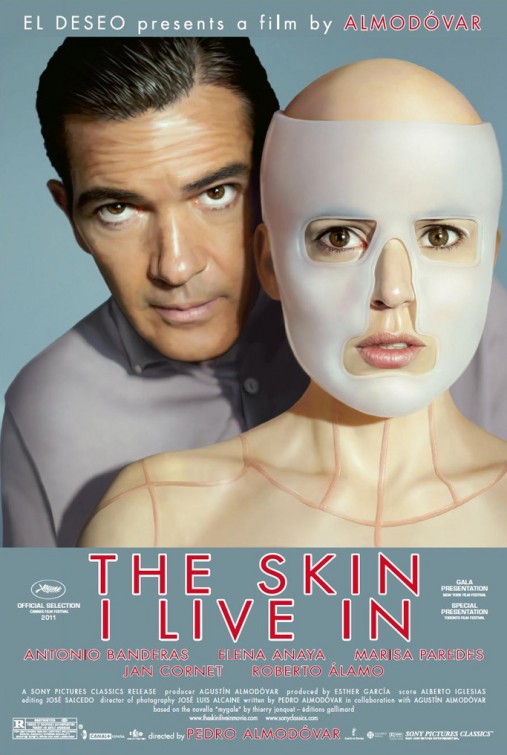
Film Review: The Skin I Live In

For his eighteenth film, the modern day, melodramatic, maypole dancing Hitchcock-in-drag Spanish moviemaker Pedro Almodóvar, has sent forth the closest thing the auteur has ever come to a true blue horror movie.  With nods to the Master's Vertigo, Franju's Eyes Without A Face (obviously) and, according to the director himself, Tom Six's Human Centipede, this somewhat loose adaptation of Thierry Jonquet's novel Tarantula, is a modern day look at loneliness, betrayal and sexual identity in the guise of a psychological thriller, all with a quirky spin all Almodóvar's own.  The director himself calls the film, "a horror story without screams or frights," but there are frights nonetheless.

The film tells the labyrinthine tale of a man obsessed and the young woman who may be more than meets the eye.  Antonio Banderas, in the actor's first film with his once regular collaborator in twenty-one years, plays a plastic surgeon who, much like Pierre Brasseur's Dr. Genessier in Eyes Without A Face, has become so obsessed with bringing back someone he has lost, that he begins to play God, blurring any line that had once been put in place as an ethics barrier.  We first meet Banderas' charmingly mad Dr. Ledgard ("The things the love of a mad man can do.") as he is watching, on a giant screen surveillance monitor next to his bed nonetheless, a woman that we soon find out is being held as a prisoner in the not-so-good doctor's home.  Vera, a stunning young woman dressed in a neck to toe body suit who wiles the long days away doing yoga, writing on the walls and creating strange dolls, is Dr. Ledgard's prisoner.  The mad scientist's own little experimental baby doll.

Played by the beautiful Elena Anaya (another Almodovar regular, Penelope Cruz, had to back out due to scheduling conflicts), Vera quickly becomes an enigma.  Is she falling for her captor?  Is she plotting another escape attempt?  Is any of this real?  But then Almodovar's entire film is an enigma - even by Almodovar standards, which are pretty lax on the whole subject of linear moviemaking in the first place.  Flashing back to six years earlier and the rape of Ledgard's own daughter and the doctor's kidnapping of yet another person, his daughter's rapist, the story begins to have more twists and turns than even the twistiest of the great Hitchcock, Almodovar's own obsession.  Add in a strange and dangerous man dressed as a tiger ("El tigre que realmente me mal estado."), a dutiful housekeeper/mother hen played by another Almodovar regular, Marisa Paredes, and some rather strange medical implements, and you have one giddily bizarro motion picture.  To say any more would demolish the waking dream of Almodovar's film, so I will let it go at that. 

Film Review: Shame

Starting out matter-of-factly enough to be considered a modern day, sex addict version of Jeanne Dielman, we watch the opening salvo as Michael Fassbender's Brandon - the titular, ostensibly shamed sexual obsessive - goes about his seemingly drudging daily and nightly routine of anonymous sex, ignoring the pleading messages on his voicemail, vigorous masturbation and online porn - all the while dragging along a seemingly worn out penis that even flaccid could easily be mistaken for a nine iron.  Now even though this same said full frontal nudity, along with some pretty graphic sexual encounters (at least graphic for a mainstream movie), saddled the film with that bottom line kick in the balls NC-17 rating, Shame is not actually about sex so much as it is about addiction.  An addiction that in this day and age could be just as dangerous, or at least just as much of a crap shoot as heroin or crack.

To further prove this is a film not about sex but about addiction, one is asked to look at the seeming sexiness of such a sexual film.  Even with all the sex that is going on (some of it peripherally, some of it full frontal and center), never once is this film sexy.  Instead, Fassbender's sex addict goes about in a veritable state of melancholy, his sexual encounters cold and formulaic, his demeanor one of diffident arrogance.  Fassbender, whose smile incidentally, the few times we get to see it, is one of both disarming charity and predatory ferocity, goes about his role as if he is a dead man walking - no emotions (well, perhaps desire and some self-loathing) and no sense of community with anyone around him (well, except for when he is fucking them).  Even when his sister comes to live with him (Carey Mulligan playing what one would call against type - and doing one hell of a job at it) we see a distance between these estranged siblings - Fassbender's cold as ice addict never letting anyone within, emotionally speaking, arm's reach.  Perhaps Fassbender's humanity is hidden away somewhere, only allowed to see the light of neoned night when he thinks no one is looking (Mulligan's haunting jazzy rendition of New York New York brings the man to unwanted tears), but he keeps it so deep inside of him that he cannot even communicate without the aid of sexuality.  This may even be more than alluded to in an incestuous way as well.

Directed by Steve McQueen (no, not that one), this highly anticipated followup to the artist-turned-filmmaker's debut feature Hunger (in which most people first became aware of how daring and remarkable an actor Herr Fassbender truly is) is a blast of sexually promiscuous arctic air.  We see a man dying on the inside, unable to open up to anyone, unwilling to give any sort of loving emotion a second thought (if he even allows them a first one), trapped inside his own addiction, needing sex, in any form (and I mean that) to feel alive, yet still feeling dead inside.  We see a man in the ups and downs of addiction - his hard drive being wiped clean at work, perusing subways and back alleys for any human touch - who finally succumbs to his self-destructive habits and hits that proverbial rock bottom of addictions.  It is McQueen who gives his film an air of coolly derisive otherwordliness (the dank subways, the saturated lighting, the aforementioned Jeanne Dielman-esque cadence), but it is the it-boy Fassbender (though judging from the full frontal shots, perhaps it-man is more apropos) who makes us feel both repulsion and empathy for this lost soul and allows us into this world of desperation, this world of the walking dead - this world of shame.

Sunday, January 15, 2012

Film Review: The Artist

Playing as homage to a lost period in the film industry, this Star is Born-esque look at the onset of the sound era, done in pin-sharp black and white and an aspect ratio that hearkens back to the smaller screened world of pre-Cinemascope Hollywood, and made as, for all intents and purposes, an actual silent film, The Artist, directed by the charmingly quaint French-born auteur Michel Hazanavicius (now there is an ironic mouthful), and starring French Douglas Fairbanks look-a-like Jean Dujardin in its titular central role, is a quite stunning film to look at - which I suppose is the best thing going for a silent movie.

Granted, the story may leave a bit to be desired - it has been done to death (then again, it is an homage after all) - but when taken as purely visual (though the score, a slew of sound effects and a handful of spoken dialogue give it an audible nuance as well) and as a sort of love story to a time long lost, the film can be a thoroughly enjoyable moviegoing experience - and damn can Hazanavicius, along with cinematographer Guillaume Schiffman, paint a pretty picture in the shadows and lights of black and white. 

Full of stunning shots (many influenced by the same German Expressionists that gave Welles and other Hollywood auteurs their legendary looks) and beautifully stylized set pieces, The Artist need not rely on such trivialities as script and story, for in the end, it is the panache that counts.  Well, that and the ability to transit from the silent era to the sound era as Dujardin's dashing swashbuckler George Valentin must do in the film.  The mostly unknown French actor (his success here - an Oscar nod is imminent - may finally get the actor's Little White Lies its long overdue US release) gives a bravura performance as this Douglas Fairbanks inspired (a bit of Rudolph Valentino may be in there too) work of silent era machismo, and it is this performance that acts as the proverbial heart and soul of the film.

But Dujardin is not alone here.   Bérénice Bejo, an even lesser known Argentinian actress (and not so coincidentally, the director's wife), plays starlet Peppy Miller (with a career trajectory that most resembles a precode Joan Crawford), the Esther Blodgett to Dujardin's Norman Maine (sans the abusive nature of the latter).  We also get a surprisingly svelte John Goodman (at least svelte by John Goodman standards) as the big boss of the studio, James Cromwell as Valentin's more than devoted man servant, and of course, Uggie as Jack the Dog, faithful companion to the big star and the has been Valentin both.  Incidentally, while Dujardin was taking home the Best Actor award at Cannes, Uggie was awarded the coveted Palm Dog (and I am not making this up).

So even if the story is not the thing legends are made of (ironic considering the legendary status of such a  so often told story), the look and feel of the film, along with the near constant homage to cinematic history - everyone from Hitchcock to Lang to Lubitsch and Murnau, to Singin' in the Rain (even Mary Pickford's house stands in for Peppy's) - more than makes up for any perceived (and they may be just that) shortcomings.  Stylish and giddily melodramatic (the silent era melodrama was Hazanavicius' biggest single influence), The Artist may only be a replicate of the edge of the silent era, (sadly we cannot bring back the past - they certainly do not make them like they used to) but what a hell of a wallop it packs into its loving homagist punch.

Friday, January 13, 2012

Anomalous Material Weekly Feature: 10 Best Kevin Spacey Performances

Here we are again true believers, with my latest weekly 10 best feature for the fine folks over at Anomalous Material.  For those of you not in the know, those same said fine folks have given me a (possibly foolish on their behalf) regular gig as feature writer.  It is a series of top ten lists on various cinematic subjects (and anyone who knows me can attest to how perfectly suited I am to such an endeavor - yes I am a  list nerd).  This week's feature, my twentieth such feature, is all about the Spaceman.  Okay, that is just my dorky way of saying that this week we are taking a look at the films of Kevin Spacey.  So go over there and check things out.

Read my feature article, "10 Best Kevin Spacey Performances" at Anomalous Material.

Thursday, January 12, 2012

Film Review: Tinker Tailor Soldier Spy

Moody and melancholic, its foggy London atmosphere chilling the screen, its grey squat buildings of 1973 Eastern Bloc Europe deadening its hopes, this latter-day adaptation of John LeCarré's 1974 classic spy thriller is near pitch perfect in its boulevard of broken dreams demeanor.  The spies shown here, played by a slew of brilliantly understated actors, have never come in from the cold (to paraphrase another LeCarré novel), and as broken down and beaten as its main protagonist, George Smiley, played with a deceptive canniness by Gary Oldman, seems to be, that too is how weathered, how battled and bedraggled this Cold War remnant shows itself to be - and that is exactly how this film should feel.

Much of this aforementioned gloomy, though appropriately so atmosphere is given its form by the apt direction of Tomas Alfredson, the Swedish director who gave us the atmospheric horror film Let the Right One In (and that's how you do a romantic vampire movie!).  A great pic to direct a pic as perversely period as this one.  Add to this the melodic setting-appropriate score by Alberto Iglesias, the composer of choice for the majority of Pedro Almodóvar's films, and the mood-setting cinematography of Hoyte van Hoytema, the man who photographed the aforementioned Swedish vampire film, and Tinker Tailor Soldier Spy is an intriguing blend of neo-noir, spy thriller and wouldbe psychological horror movie, all rolled into a chilling, classically-styled cold war entanglement of red herrings and MacGuffins galore.

But it is in this very same convoluted screenplay where TTSS begins to unravel - or perhaps never quite ravels enough.   Many have said (I have not read the book myself) that LeCarré's labyrinthine novel is way too much to capture in a feature length work of cinema, and that even the nearly five hour 1979 UK mini-series version could hardly handle the multitudes of twists and turns that LeCarré had put into his bestseller.  This may very well be true as we see a lot of random threads go in and out here, without ever receiving any sort of denouement, and even though the film is not that particularly difficult to follow (many of its detractors claim it to be close to incoherent), the screenplay by Bridget O'Conner and Peter Straughan, seems at times lazy, but at others downright bewildered and bewildering.  But then this may just be bellyaching on my part considering how in tune every other layer of the film is with what this spy thriller needs to be. 

So while the acting is top notch - not just Oldman, but John Hurt, Mark Strong, Toby Jones, Benedict Cumberbatch and especially Tom Hardy and Colin Firth - replete with immaculately enunciated spytalk and desperate longing, and Alfredson's concoction of 1970's period drama is near pitch perfect, the film seems to fall a bit flat when it comes to its rendering of a storyline.  This is no truer than in the end, when we finally find out just who the searched for spy actually is, and a feeling of ending not with a bang but with a whimper reverberates throughout this cold cold work of cinematic fiction - especially  when the films leads, crescendo like, to what should be a big bang.   Then again, this is just the culmination of a rather workingman ethic of the time period, so perhaps it does work in a way. - and perhaps this is just bellyaching on my part.  But whatever the case, just to feel the long dead paranoiac atmosphere of Soviet spies and wondering just who is listening in, is worth having to put up with a little less than what meets the eye.

Wednesday, January 11, 2012

Film Review: The Girl With the Dragon Tattoo

I must admit to not being much of a fan of the original Swedish trilogy (and I haven't even read the bestselling novels they in turn were based upon!), and I am far from a proponent of Hollywood remaking every successful foreign film they can get their hungry little hands on (why can't American movie audiences just watch a damned subtitled film!?), but put a daring director like David Fincher behind the wheel and place a surprisingly powerful, relatively unknown actress like Rooney Mara as the titular tattooed lady, and you can certainly colour me impressed.

If I had any trepidation going in it would have been on the question of the brutality that was so inherent in the original series, and if a mainstream studio project (and Oscar hopeful to boot) would allow such unapologetic cruelty to be part of its make-up - even when that same said cruelty was integral to telling such a story.  My hopes for such a positive transition from European art house to playing in Peoria were taken pretty high when I first heard that Fincher would be taking the reigns, but they went through the proverbial roof when I finally saw the picture and realized, from the very onset of the succulent black and white opening titles that looked as if they creeped out of a oil-drenched Bosch nightmare, that no one put this baby in a corner.  

Without wavering, Fincher kept the film as brutal and as harrowing as it needed to be.  The director even said, when he was first attached to the film, that he would not soft-peddle the literary content, and that this would be a "Hard R" rated movie.  This may be a turn off for those on the squeamish side (the aforementioned brutality is certainly nothing to be trifled with), but to the fan of the books and/or the original trilogy who want the best adaptation money can buy, and to someone like me who believes in balls-to-the-wall filmmaking, it is the most necessary of evils.  But still, the brutality is only the surface of this intricate and rather convoluted film (sometimes the storyline can more than border on the ridiculous) - the real stuff comes with the performance of Ms. Mara as the socially maladjusted computer hacker genius heroine of the whole shebang.

Setting aside the more than capable performances of Daniel Craig as the inquisitive lead Mikael Blomkvist, Christopher Plummer as the head of the most fucked-up family in Sweden and Stellan SkarsgÃ¥rd as an appropriately slimy wouldbe villain, this is Rooney Mara's film to either sink or swim with.  As tattooed cover girl Lisbeth Salander, Mara (her closest claim to fame being her brief appearence as Jesse Eisenberg's rightfully jaded ex-girlfriend in Fincher's The Social Network) is a steely-eyed force of unnatural nature that can wreak revenge on a repugnant rapist with one hand (clasped around a tattoo gun or a lead pipe) while downloading the most encrypted of code to unearth a sadistic killer of women with the other. 

Complete with a soundtrack from (Oscar Winners!!) Trent Reznor and Atticus Ross, and a roving, aggressive camera that has Fincher written all over its audacious brouhaha, Mara's bodacious performance - a more wily and humanistic version of Noomi Rapace's original Lisbeth - takes this film head and shoulders above the original (a rare thing indeed) and gives the film, even with any viewer of the original knowing exactly what is coming, a true sense of dread and danger.  I still say Hollywood should stop trying to remake every foreign film they can, but in this rare case it actually worked.  Imagine that.

Monday, January 9, 2012

My 25 (or so) Favourite Classic Films First Seen in 2011

Inspired by the always charming, always enjoyable and always cinematically knowledgeable (and always alliterative, nomenclaturally speaking) Self-Styled Siren, I send forth a list of my 25 favourite classic films seen for the first time in 2011.  Classic, of course, being any movie made prior to 1960.  And in keeping with the Siren's choice of keeping the descriptions to a bare bones minimum (actually inspired in turn by Clara at Via Margutta 51) I will try to hold my typically long-winded ramblings to a relative bare bones minimum as well.  So without further ado, here are my favourite classic films seen for the first time in 2011.

Oh wait!   I do have some further ado to put forth - and possibly some rambling (see, I have already begun breaking promises).  In order to keep this list to a nice and tidy twenty-five (yeah, right) I would like to preface said list with a pair of special mentions.  

Powell/Pressburger: It is a rather sad fact but before this past year I had only seen three films by this brilliant British filmmaking duo known collectively as the Archers (Black Narcissus, Tales of Hoffman & of course The Red Shoes - my all-time favourite film if one wishes to keep track of such things).    In 2011, I almost doubled my Powell/Pressburger film viewing prowess, by seeing five of their films for the very first time.   These five films (in order of preference) are The Life and Death of Colonel Blimp, A Canterbury Tale, Gone to Earth, A Matter of Life and Death & Oh...Rosalinda!!.  Any one of these films could feasibly take the top spot on the below list, so since they are so many and so superior (at least mostly), I have decided to put them in a class all their own.   In actuality this is merely a ploy (a clever ruse if you will) to make more room on the list for even more films since I could not narrow my list down very easily.  The other special mention (just below) is another ploy to do the same damn thing.

Douglas Sirk:  Believe it or not, prior to 2011, I had never seen a film directed by Herr Sirk.  This sad fact was remedied last year by seeing five of his great melodramas (again, in order of preference) - Imitation of Life, Written on the Wind, All That Heaven Allows, Magnificent Obsession & A Time to Live and a Time to Die.  Again, I believe these to be the proverbial head and shoulders above most of the films I saw in 2011, so they too will get a class all their own.  And again, this is merely part of the aforementioned ploy.  But enough of this.  I promised not to ramble on, so now, (really) without further ado, I give you my 25 favourite classic films seen for the first time in 2011.  I have tried to list these films in relative preferential order, but I think we all know how that ends up, so take the numbering order in any manner you see fit.  Now here they are.

1) Leave Her to Heaven (John Stahl, 1945) - Beautiful and sinister as hell, and with the sexiest overbite in the history of Hollywood, this is Gene Tierney at her wicked best - and the glorious Technicolor (wonderfully and appropriately artificial) looks almost as good as she does.  If you do not believe me, just check out that look she is giving you right now.

2) Cairo Station (Youssef Chahine, 1958) - Very possibly the least known film on this list, this Egyptian film noir(ish) masterpiece (yeah!  I called it that!) is like having Hawks, Hitchcock, Welles, Curtiz and Antonioni all rolled into one.

3) Rififi (Jules Dassin, 1955) - Taking its place as my new favourite crime caper movie (my new second favourite of the genre can be seen in the number eight spot below), this French heist film is , to borrow an attitude from Mae West, great when it is loud but even greater when it doesn't say a word.

4) Rancho Notorious (Fritz Lang, 1952) - The best thing to come out of Lang's Hollywood years, and a campy deeelight full of Marlene mayhem (looking a bit older than what she wanted to) and Mel Ferrer and his toothy, snarky grin.  Fun stuff indeed.  My review can be read here.

5) The Last Flight (William Dieterle, 1931) - If the Siren can wax poetic about Edmund Goulding then I can turn critical cartwheels over William Dieterle.  What a great forgotten film (a loving piece in Film Comment made me seek it out), highlighting the equally forgotten (sad as that may be) Richard Barthelmess, David Manners, John Mack Brown and Helen Chandler.  My review can be read here.

6) Partie de campagne (Jean Renoir, 1936) - How could it not be gorgeous - it's Renoir - but even by Renoir standards this forty minute film, based on a short story by Guy de Maupassant, and centered around the drop dead gorgeous Sylvia Bataille as an objet d'art, is a complete stunner.

7) Mädchen in Uniform (Leontine Sagen, 1931) - Even taking the sexy lesbian schoolgirl factor out of the mix (I am a guy after all), this early German sound film is more than well worth a look - a long look indeed.  In fact one could (and should) call this film haunting - a term that could go all cliché if one is not careful, but that is not the case here.  Seriously though, this is a very powerful film indeed.  My review can be read here.

8) The Killing (Stanley Kubrick, 1956) - Kubrick's rather demanding style has always appealed to me, and in this early work (his third) you can see that style hidden inside a more classic style.  A great crime caper movie (my second favourite of the genre - see number 3 above) and easy to see the influence on Tarantino later on.

9) The Shanghai Gesture (Josef von Sternberg, 1941) - Another Gene Tierney vehicle (I suppose I was going through a Tierney phase in 2011), this rather sleazy, giddily B-grade picture was a delight from beginning to end.  And not just Tierney (and that overbite) but also Victor Mature (I did say sleazy) and Ona Munson as Mother Gin Sling.  Great stuff indeed.

10) The Phantom Carriage (Victor Sjöström, 1921) - One of the creepiest and greatest silent films ever made.  Who knew the Swedes could pull of as much silent era intensity and visual bravura as the Germans.

11) 12 Angry Men (Sidney Lumet, 1957) - It is kind of shocking that I went through the first 43 years of my life (the first few understandably so) without ever seeing this film.  Intense and brilliant, this film is the perfect blend of writing, directing and acting.  And the scene where everyone, even the assholes in the group, turn their backs on the racist played by Ed Begley, is simply perfect.

12) The Cobweb (Vincente Minnelli, 1955) - One of the great Minnelli's lesser known works, and a film that is seen as too melodramatic by many, but I was blown away (as they say) by the damned thing.  Granted, I like pretty much anything with Richard Widmark in it, and Gloria Grahame is ooh la la great just about every time out, and I prefer the overly melodramatic, so it was probably a forgone conclusion that I would love this picture.  My review (actually more a list of my 10 favourite things about the film) can be read here.

13) Captain Blood (Michael Curtiz, 1935) - Swashbuckling at its very best.  I think I can call this the greatest pirate movie ever made and I would not get much argument.  Errol Flynn and Olivia de Havilland (their first of an eventual eight films together) and Basil Rathbone as the villain.  What more need be said.  Ahoy mateys, ahoy.

14) Forbidden Planet (Fred M. Wilcox, 1956) - A cool and pretty keen fifties sci-fi classic (based on The Tempest of all things) that shows a young, pre-parody, Leslie Nielsen as the heroic but somewhat hapless captain of a spacecraft trapped on the titular planet and a very highlighted, and very leggy Anne Francis as the object of the Captain's (and everyone else's) affections.  Oh yeah, and Robby the Robot too.  My review can be read here.

15) The Wild One (László Benedek, 1953) - This is the movie that has Brando in leather, with a revving, hulking machine roaring between his legs.  No, not Last Tango in Paris.  THis is the one with the motorcycles (get your mind out of the gutter).  Cool as can be - and with Lee Marvin to boot.  My review can be read here.

16) The Steel Helmet (Samuel Fuller, 1951) - Just Fuller's third film and already that growling Fullerian intensity is fully intact.  Thanx to Criterion's great Eclipse series for getting this one two me in such pristine form.  I think I would have to include this in any 10 Favourite war movies list I were to make.

17) The Invasion of the Body Snatchers (Don Siegel, 1956) - Seen during my summer kick of 1950's sci-fi/fantasy films, this is one of the creepiest movies I saw all year. It just goes and goes and never lets up - not even in the end.

18) Bienvenido Mr. Marshall (Luis Garcia Berlanga, 1953) - I must admit to never having heard of the director before coming across three of his films during My Quest, but I sure am glad I have finally found him.  A screwball kind of film, Berlanga can be called a Spanish Billy Wilder without much fuss.

19) Caged (John Cromwell, 1950) - Subversive and more than bordering on the exploitative, this is a harrowing film and Eleanor Parker hands in a frazzled, frenzied but oh so chilling performance as an innocent turned jaded caged bird.  My review can be read here.

20) The Ballad of Narayama (Keisuke Kinoshita, 1958) - Forget Ozu.  Forget Kurosawa.  Forget Mizoguchi and Naruse.  2011 was the year that turned Keisuke Kinoshita into my favourite classic Japanese director.  This film is just beautiful as Kinoshita does wonders with colour.

21) The Silver Chalice (Victor Saville, 1954) - Mockingly nicknamed Paul Newman and the Holy Grail, and hated by Newman himself (this debut film would be the scorn of the actor's career), I quite enjoyed this rather laughable movie just for the very fact that it is so laughable.  And at the top of this laughability - Jack Palance at his most campiest (no need to shut the closet on this performance).  My review can be read here.

22) The Hurricane (John Ford, 1937) - Aside from the fun I had watching this while an actual hurricane was raging outside (or at least the more inland version of such), this is a very fun film in and of itself.  Plus we get to see Dorothy Lamour tied to a palm tree.  My review (or at least some thoughts on the film) can be read here.

23) Fig Leaves (Howard Hawks, 1925) - Howard Hawks does The Flintstones.  This was a surprisingly fun film to watch.  Granted, it was Hawks and I am certainly what one would call a Hitchcocko-Hawksian, but I still did not expect as much out of this silent film as I got.  Seriously, did Hanna and Barbara see this film before creating The Flintstones?  And if you watch, you will see that Howard Hawks invented the snooze alarm.  My review can be read here.

24) The Outlaw (Howard Hughes, 1943) - I think the fact that Howard Hughes invented the underwire bra specifically for Jane Russell (in her film debut) to wear, makes this a very interesting behind-the-scenes tale.  The movie itself is rather simple (Hughes is not a great director), but Russell makes it her own with her very own pair of great assets.

25) My Favorite Wife (Garson Kanin, 1940) - I think the most fun about watching this screwball comedy is watching how nervous the muscled, mostly naked body of Randolph Scott seems to make Cary Grant - especially considering the real life relationship between the two.  It doesn't hurt that Leo McCarey wrote the thing as well.

I could easily keep this list going with such first time fun as Designing Woman, Mr. Blandings Builds His Dream House, Blessed Event, Criminal Code, So Young So Bad, Detour, The Miracle Woman, Run For Cover, Untamed, Crossfire, The Egyptian, Ceiling Zero, Girls of the Road, The Hitch-Hiker, The Medium, East of Borneo, Land of the Pharaohs, Side Street, Stranger on the Third Floor and both versions of Dawn Patrol

Also, I suppose a special mention should be made for a great double feature I saw for the first time in 2011.  The Girl Can't Help It and Will Success Spoil Rock Hunter?, both directed by Frank Tashlin and the first two starring roles for Jayne Mansfield, are a great pair of self-referential comedies - and I do love self-referential comedies.

One last thing before I shuffle off.  As I made mention to above, I spent a lot of film-watching hours this past summer in the genre of 1950's Sci-fi - most of which I had never seen.  Some of these were really good (The Man From Planet X, Invaders From Mars, Earth vs. the Flying Saucers) while some were pretty laughable (The Monolith Monsters, Robot Monster, Attack of the 50 Foot Woman) but they were all pretty darn fun - even if in the cheesiest kind of way.  In fact I liked these films so much that I even did a 10 Best 1950's Sci-Fi list for them over at Anomalous Material.

Once again I would like to thank the Self-Styled Siren for her inspiration in making this list.  I hope to do it again next year, and that may include some of the films I have gleaned off of the Siren's list, and will watch for the first time in 2012.

Friday, January 6, 2012

Film Review: Attack the Block

An ode in many ways, to John Carpenter's classic 1976 subversive genre work Assault on Precinct 13 - so much so in fact, that there is no way in hell that writer-director Joe Cornish is not a fan of the aforementioned Carpenter pic - the UK hit import Attack the Block takes the typically B-movie idea of the alien invasion film, tosses it on its head and hands us its deconstructed carcass like a trophy of its cinematic bravura and chutzpah.  In other words, I really really liked this movie - and you probably should too.

Starting out on the dangerous streets of a South London project on what appears to be Guy Fawkes Night, as the fireworks sis boom bah through the night, a gang of five masked teenage hoodlums mug a young woman walking back to her flat, only to be interrupted mid-mugging by a falling projectile that demolishes a parked car nearby.  Needless to say this is the beginning of an alien invasion that ends up forcing muggers and muggee, along with the local drug lord and a pair of seemingly clueless potheads (one played by the ubiquitously goofball Nick Frost) and a couple of cocksure little kid gangbanger wannabes, to team up and save the planet - or at least save the block since it appears to be an extremely localized alien invasion.  With alien beasts replacing the L.A. gang members of Carpenter's Precinct 13 (which in essence were just that director's answer to the walking dead in Night of the Living Dead), and with a tongue-in-cheek satiric tone (Edgar 'Shaun of the Dead' Wright acts as exec producer), Attack the Block is a real kick in the head - for genre fans and non-fanboys alike.

As the hulking, black-furred aliens, impossibly giant sets of fangs glowing in the dark like fluorescent shards of impending death (think the gargoyles from Ghostbusters mixed with the blackest of black bears and something out of an acid-induced Dark Crystal nightmare), make their way into this towering den of iniquity, trapping our not-so-intrepid heroes inside with only each other, enemy and friend alike, to count on, Cornish's film - his directorial feature debut btw - becomes more and more claustrophobic and more and more dangerous.  Fighting the seemingly inevitable destruction of the world, or at least the titular block, collateral and non-collateral damage being ripped to shreds through the halls and elevators around them, this ragtag band of survivors - again, much aligned to the same sort of doomed group from the aforementioned Carpenter classic - Attack the Block is a nearly non-stop adrenaline rush from start to finish.  All-in-all, pretty fucking nifty for such a supposedly B-picture mentality - or perhaps pretty fucking nifty because of its B-picture mentality.

Thursday, January 5, 2012

Film Review: War Horse

Despite his irregularly inflated reputation among those movie going masses that flock in droves to see the director's works (and hand him inevitable yet inexplicable accolades), and in spite of the fact that the man can shell out one hell of a good action yarn, making his war torn movies explode with visual audacity, Steven Spielberg can be an extremely cloying, emotionally manipulative and downright syrupy filmmaker.  With War Horse, his epic-wannabe World War I heart-tugging adventure story of a young man and his horse (or actually of a horse and his young man), Spielberg has accomplished to gather both sides of his filmmaking personality, the exciting actioner and the trite manipulator, into one fell cinematic swoop.

Playing at plastic emotions as always, the first act of Spielberg's movie, set in the rolling hills of Devon, England, is one long roiling melodrama of heart and hope and typical Spielbergian hooey.  Once we get into the trenches of WWI France, the film predictably picks up, as the director's true forte is action - and he gives us plenty of it.  As we follow this heroic yet somewhat hapless horse around the battlefields of war torn Europe, at times a steely mount of the allies, and at other times a bruised and battered pack animal of those damned pointy-helmeted boys of the Kaiser, the adventure is ofttimes quite spectacular.  One scene in particular, as we see our intrepid hero running through the ramparts of war, leaping across trenches and facing down tanks, bravely rescuing a fellow equine, charging full throttle through the barbed wire terrors of war, is easily one of the ten or fifteen best filmed sequences in any movie this year.  Sadly though, as the war happily comes to an end, Spielberg throttles it back into the oversentimentalized (and this complaint is coming from a very sentimental critic) tropes that give his films such an unneeded extra layer of thick fattening sauce.

I suppose when all is finally said and done, War Horse is not a terrible film, but then again it is certainly not a film I can recommend to anyone but the die hard Spielbergian filmgoer - whoever they may be.   I once (half-jokingly) included the first twenty minutes of Spielberg's 1998 war opus Saving Private Ryan in my best of the year list, and I could probably do the same here, though War Horse's powerful twenty minutes or so are scattered in pieces throughout, and unlike the aforementioned Private Ryan, these few saving graces are not enough to rescue an otherwise trembling piece of manipulatively emotional moviemaking as War Horse ends up being.  In the end, the better bet would be to go and see the contemporaneously released other Spielberg movie, The Adventures of Tintin (made by the action-fueled side of the director and hence a much better picture) and leave this trying film in the dark - even with its inevitably demanded forthcoming Oscar nominations (cloying has always done rather well at Oscar time) in tow.

Tuesday, January 3, 2012

Anomalous Material Weekly Feature: 10 Best Animated Movies

Here we are again true believers, with my latest weekly 10 best feature for the fine folks over at Anomalous Material.  For those of you not in the know, those same said fine folks have given me a (possibly foolish on their behalf) regular gig as feature writer.  It is a series of top ten lists on various cinematic subjects (and anyone who knows me can attest to how perfectly suited I am to such an endeavor - yes I am a  list nerd).  This week's feature, my nineteenth such feature, is all about the animated side of cinema.  Taking a look at the history of animated motion pictures - a history that is nearly as long as cinema itself - I send forth my choices for the ten best animated feature films of all-time.

Read my feature article, "10 Best Animated Movies" at Anomalous Material.

As an added bonus (see screenshot below), the film that would have come in at number eleven if I had extended my list, is the 1926 German film The Adventures of Prince Achmed, directed by Lotte Reiniger.  It holds the honour of being the earliest surviving animated feature film.  Done in a magic lantern/silhouette cutout technique, it is a wonder to behold.  It is a good enough film to make me second guess leaving off the list, but alas, I do not wish to go back and disrupt such a list, so off it will stay - until I make my inevitable Top 100 Animated Features list later this year.