Showing posts with label French Cinema. Show all posts

Saturday, November 30, 2013

Film Review: Abdellatif Kechiche's Blue is the Warmest Color

A three hour French lesbian drama, where one of the characters is underage, and where the director and actresses are publicly battling over supposed mistreatment on set, and all saddled with the dreaded NC-17 rating here in the states (in France, you only need be twelve to buy a ticket), is not going to be the film that brings 'em into the multiplexes of middle America.  Well, damn good thing too, I say.  This film is too good for the likes of such people anyway.  And let's face it, most of conservative middle class America would probably walk out sometime during the ten minute, unsimulated and uncompromising sex scene in the middle of the film.  Leave those moviegoers to the franchise makers and luke warm rom coms of modern day Hollywood.  Leave those people to the oh so drab so-called indie fare that pretends to be cutting edge material running around the less and less discerning arthouse of the day.  Leave the truly daring art films to those of us who know how to enjoy such things.  Basically, what I am saying is, let those who can, enjoy one of the best films of the past year, maybe even several years, maybe even decade.  Let us enjoy, Blue is the Warmest Color.

What is the story anyway?  Glad you asked.  Loosely based on the 2010 graphic novel of the same name by Julie Maroh (I say loosely since even though the basic storyline of the film follows the novel, there are several major differences - one quite major indeed) Kechiche's film is about the love story between a high school girl just now struggling with her sexuality, and what is expected of her in today's society, and the slightly older art school woman with whom she falls immediately and madly and deeply in love.  Being French, the film never delves very deep into what Hollywood would perceive as a necessary melodrama, instead opting for a fluid storyline that never finds the need to explain itself all too much.  With that style, the film allows the two actresses the freedom to pull off two of the finest, subtly provocative performances of recent years.  These two actresses are the mostly unknown Adele Exarchopoulos (Oscar talk, albeit of the dark horse variety, is starting to buzz about) as Adele (the character's name was changed from the much better Clementine of the novel), the young sexually awakening protagonist of the love story, and the somewhat better known Lea Seydoux (Farewell My Queen, Inglourious Basterds) as Emma, Adele's blue-haired objet de amour (and yes, blue is a colour that runs through the movie like a sweetly overpowering palette).  Both give stunning, naturalistic performances, that compliment the smooth, realistic direction of Kechiche.

Yet, the controversy surrounding the film, from the blatant sexuality to word of laughter during Academy screenings to the director badmouthing the film and his actresses, not to mention the dreaded mark of Cain, ie the NC-17 rating, even with its pedigree of a Cannes victory last May, certainly makes the film a tough sell in US multiplexes (even many arthouses are fearful of booking the film) but it is just as certainly a film that should be seen by those who love honest, sometimes brutally so, storytelling, and bravura filmmaking that hearkens toward the cinema of the Dardenne Brothers (much of Blue reminded this critic of the Dardenne's Rosetta).  It's a real shame that many in this country will not see this film, but as I said before, such people probably do not deserve to see such a film full of stark and unblinking beauty as Blue is the Warmest Colour.  I'm just glad I wasn't one of those undeserving masses, for this is a film that will most certainly be a major player in my yearly best of list.  If you are lucky, it may very well be in yours as well.


Monday, May 27, 2013

Film Review: Gilles Bourdos' Renoir

I do not trust the cinematic taste of anyone who does not include Jean Renoir in their list of the greatest directors.  The cinematic equivalent of Proust in literature or Dylan in music, Renoir modernized film, and helped give birth to a new sensibility in moviemaking.  Known as the patron saint of the French Nouvelle vague, or New Wave if you will, and one of the biggest influences on Italian Neo-Realism, Renoir made everything after him, from Godard and Truffaut to Visconti and Fellini to Scorsese and Resnais, possible.  Granted, there were other contemporaries of Renoir of equal stature and influence - Welles, Lang, Chaplin, Lubitsch and Hitchcock come immediately to mind - but to say Renoir changed the way modern film was made, or at the very least was one of modern cinema's most influential entities, is not just mere hyperbole, it is ground-in-truth fact - and anyone who says otherwise just ain't copacetic in my book.  But then, I am not here to wag on and on about my love and respect for M. Renoir, but instead, to discuss a new biopic about, not just Renoir the younger, but of his father, Pierre-Auguste, as well.

Taking place during the horrors of World World I, though far removed from the front lines, Gilles Bourdos' Renoir, is actually the story of Andrée Heuschling (later Catherine Hessling) who was the beautiful young model of pere Renoir and the later wife of, and actress for, the younger Renoir, and how she was the bridge between generations of great artistic men.  The reason I went all gaga over our intrepid filmmaker in my opening paragraph is due to the fact that I really do not have all that much to say about the film itself.   Neither a great work of art nor a trainwreck of a movie, Bourdos' film is highlighted merely by the look of the film - it's visual cadence, if you will.  Dressed up to look somewhat like an impressionist painting, the film has an inherent beauty in its palette, even if it does not manage to sweep us away with its narrative or acting.  Sure, Michel Bouquet, Claude Chabrol's go-to guy back in the day, does a fine piece of acting as the great impressionist painter, but the other two leads, Vincent Rottiers and Christa Theret, as future director and flame-haired muse, respectively, are painfully boring in the roles.  Mainly just able to look pretty, which for anyone who has ever seen a picture of Jean Renoir knows, that has never really been the case, these two just swoon about in and out of the aforementioned painterly cinematography of Mark Lee Ping Bin of The Flowers of Shanghai and In the Mood For Love fame (he shared credit with Christopher Doyle on the latter).

Never much of a fan of biopics, especially biopics of favourite directors - and yes, I realize this is not technically a biopic of Jean Renoir, the filmmaker, as the film ends a good five years before the great man ever even steps behind a camera, but it is close enough to count here - the film was destined to not exactly float my so-called boat - and float it, it did not.  Better than Richard Linklater's feeble Me and Orson Welles (though the central performance there, by British actor Christian McKay, is dead on perfect) or the equally feeble, though again, well acted, My Week with Marilyn or last year's doubly feeble Hitchcock, Renoir nonetheless never impresses enough to be called something spectacular.  As I said, not a bad film, but certainly nothing great either, and outside of the visual aspects of the film, this film never catches fire as damn well it should.  And, in the end, a mediocre movie is oft times a worse travesty than making a truly terrible picture.  At least when legendary auteur du affreux Ed Wood made one of his monstrosities, there was love behind them - even if it was a tilted, cock-eyed kind of love - but when one makes a middle-of-the-road thing, much like Bourdos has done here, that love seems to be on a break from the relationship.  If anything, this film has made me want to go and rewatch all of Renoir's oeuvre - not that such a thing would take much of a push - or maybe check out pere Renoir's work at the closest museum.


Monday, December 3, 2012

Film Review: Leos Carax' Holy Motors

It is not an easy task to try to describe Leos Carax' Holy Motors.  I suppose some would say it is not an easy task to watch Holy Motors either, or for that matter to understand the damn thing, but whether one "gets" what Carax, and his muse, actor Denis Lavant, are trying to do here - and I may be only partially sure myself - one cannot deny that there is a certain strangeness about the whole thing that makes it extremely difficult to ignore.  But then, I do live by the critical creed set forth by Jonas Mekas, who said, "It is not my business to tell you what it's about. My business is to get excited about it, to bring it to your attention. I am a raving maniac of the cinema."  So let us not even try to describe Carax' quite batshitcrazy film.  Instead, let me bring it to your attention, appropriately enough, as a raving maniac of the cinema.

Basically, to toss in just a bit of explanation, the film is about Oscar, played by the aforementioned M. Lavant, who is chauffeured about the streets of Paris, in a white stretch limo, getting out only to perform what what must assume are little movies, all done in various different costumes and make-up.  Never are we let in on why he is doing this, nor whom is paying him to do this, nor what any of these acts (called appointments by his limo driver/assistant) have to do with each other.  We are left wandering through a cinematic wasteland of unanswered, and possibly unanswerable, questions.  We see our intrepid actor become a a hunchbacked homeless woman begging along the seine, a dying man in what appears to be some sort of contrived deathbed melodrama, a gangster, the father of a teenage daughter (or is that part his actual reality?), and a monstrous madman (a certain Monsieur Merde, whom Lavant first played in Carax' segment of the 2008 omnibus film Tokyo!), running through the catacombs with a kidnapped model over his shoulder. 

Of course none of this so-called description of the plot, or what there is of one, manages to in any way properly explain just what the hell Carax had in mind while making Holy Motors, the director's  first feature film in thirteen years.  Perhaps it is an experiment in meta-fiction, where we are watching dreams inside dreams, all playing out as movies within movies.  With a definite Lynchian flare to much of the film, Carax pays homage to both modern and classic cinema.  There is an especially obvious nod to Franju's Eyes Without a Face, but one can see not only that film, but also the works of many others, from Feuillade to Buñuel to the aforementioned Mr. Lynch.  In this film, we see film itself, playing out in the strangest of cinematic self-love affairs, and no amount of description or explanation would make it work any better in any of our minds.  This is a film that needs not to be analyzed or intellectualized, but rather to be felt and experienced and fall head over heels into, just as real cinema, the kind that like this, can best be described (there's that word again) as cinema for cinema's sake, should be.  It is a film that was made by a raving maniac of the cinema, and in all the glory with which that entails, it should be nothing else.  Now go see what you think.

Sunday, November 11, 2012

Battle Royale #7: Battle of the New Wave (The Results)

We had ourselves a little technical trouble this time around, which is why the poll widget looks a bit different than in past days, and is why we extended the voting period by a week, but everything is back on track now, and we are finally ready to declare ourselves a winner - even if CNN still isn't ready to call Florida.  That latter bit was a rather topical election joke that may or may not stand the test of time.  Anyway, onto the results.

For this round, you were asked to make your decision between the duo known as the vanguard of the French New wave.  Did your vote go to François Truffaut, or are you more of a Jean-Luc Godard kind of person?  Well, as has been the case in every Battle Royale so far, it was a close race from beginning to end, appearing to maybe coming down to a veritable photo finish, but then some last minute precincts came in (another topical election reference that will probably bewilder future readers), and one candidate shot out in front - and stayed there.  That candidate was, and still is, Monsieur Jean-Luc Godard.  With a final tally of 34 to 30 (or 53% to 47% for the statistically-minded among us) the man who directed Breathless beat out the guy who wrote Breathless (and directed a few films as well).  My own vote, as one should already have figured out by looking at the avatar/profile pic I use everywhere, went to our eventual winner (based solely on the auteur's first decade - do not get me started on what the director has become lately) but this was a tougher decision than I expected it to be.  When I wore a younger man's clothes (wow, did I just quote Billy Joel!?) I was much more a fan of the films of Godard over Truffaut, but as I grow (and in theory, mature?) I see that gap between the director's getting smaller and smaller.  Perhaps someday, maybe someday soon, the gap will cease to exist, and after a crossing of the streams, said gap will go in the other direction.  Anyway, for now I am still on the Godard side of things, but who knows what the future will bring.  So there you go.  

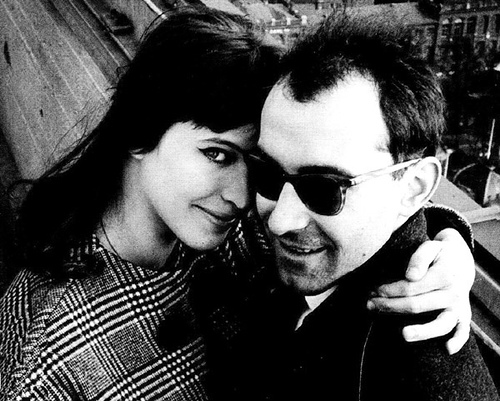
In other news, our total vote count this time around, for those who do not care to do the math, was 64 - just two votes shy of the Battle Royale record of 66 held by the classic Astaire/Kelly bout.  I know we can beat those numbers next time around.  Let's shoot for triple digits, shall we?  Yes we shall.  Anyway, that aforementioned next time around will be coming around in just a few days, and this time it's going to be more than just one on one.  Perhaps it will end up being three on three (or four).  See ya soon.  And congratulations to M. Godard, here pictured with muse and wife Anna Karina.

Thursday, October 18, 2012

Battle Royale #7: Battle of the New Wave

Welcome to the seventh Battle Royale here at The Most Beautiful Fraud in the World.   It is an ongoing series that will pit two classic cinematic greats against each other - and you can vote for who is the greater by clicking your choice over in the poll at the top of the sidebar.

With our seventh edition of Battle Royale, I have decided to bring this usually classic Hollywood based contest into the modern day.  Well, by modern day, I am talking the 1960's - at least mainly.  This time around you are being asked to decide between those two rabble-rousing, young buck, revolutionary critics-turned-filmmakers (though I should probably say critics-turned-auteurs) who began it all with the Nouvelle Vague, or the French New Wave if you will, way back in 1959.  Now yes, there were a whole gang of cinematic thugs (and I use that term quite lovingly indeed) that helped create what would become known as the aforementioned Nouvelle Vague - Claude Chabrol arguably was the first to release a New Wave film, and Jacques Rivette, Eric Rohmer, Alain Resnais, Jacques Demy and others were among the creative forces in the movement, but let's face it, it's all about Godard and Truffaut, and we know it.

François Truffaut, the man who, while writing for Cahiers du Cinema, gave us the auteur theory (later expanded and espoused by NY film critic Andrew Sarris) was the heart of the movement while fellow compatriot Jean Luc Godard was its brains - or perhaps the guts.  Your mission, if you accept it, is to pick the one you think is the greater filmmaker - the greater auteur.  Is it the romantic who gave us the acerbic sentimentalism of The 400 Blows or is it the man who broke it all open with Breathless a year later?  The man who brought us Jules et Jim and the Antoine Doinel series or the one who gave us Contempt, Band of Outsiders and Week-end?  The man who said "Film lovers are sick people" or the man who said "Cinema is the most beautiful fraud in the world" (sounds familiar, eh)?  It is a battle between all the Truffaut lovers and all the Godard heads out there.  The decision is yours o faithful readers and true believers.  All you need do is go on over to the poll (found conveniently near the top of the sidebar) and vote your collective little hearts out.

And please remember that one must go over to the poll to have one's vote counted.  You can babble away in the comments section all you want (and that is certainly something I encourage, as we never get enough feedback around these parts) but to have your vote count, you must click on your choice in the poll.  And also, please go and tell all your friends to vote as well.  Our biggest voter turnout since starting the Battle Royale series has been just 66 votes.  I know we can get that number to a cool one hundred before it is all said and done and the proverbial smoke does its proverbial clearing.  The voting period will last two weeks, so get out there and vote people, because all you sick film lovers out there who love the beautiful fraud that is cinema, will definitely need to be in on this one.


Sunday, September 30, 2012

Film Review: Guillaume Canet's Little White Lies

Originally released in France in October of 2010 - to boffo box office by the way - this quite wonderful little film (a film that some have tossed off as merely a French Big Chill - a line that though somewhat accurate nevertheless sells it very very short) is a film that by all intents and purposes should have gotten a big release here in the states a year ago.  Now of course when I say "big" I mean foreign film big, which I suppose is small by most standards, but you get the picture - the film should have played big here in the US, if not in 2011, when I had the good fortune to catch it on a French DVD release, then at least in early 2012 when one of its cast members, a certain Monsieur Jean Dujardin, was running about Tinsel Town, getting every award possible, from the Golden Globe to the Academy Award to the Nickelodeon Kid's Choice Award.  Okay, the latter one may be a lie, but suffice it to say that timing the US release with such an obvious goldmine time as the post Oscar doldrums, when nothing else of any real matter is ever released and the first Frenchman to take home the Oscar (granted, in a rather small role here) is still fresh in the minds of moviegoers, would have been the way to go.

This of course never happened.  Perhaps due to rights issues, perhaps due to just poor planning, I do not know. Granted, its running time of 154 minutes could be a turn-off for American audiences (though that is still shorter than more than half of the Harry Potter films, and they did not do so poorly) but in every other aspect it just spells big box office.  Of course again, I mean "big" as in foreign film big.  But all this past speculation is now simply null and void, as this past August has finally given us the long-anticipated US release of the film in question, Little White Lies, whose original title is actually Les Petits Mouchoirs, or The Small Handkerchiefs, which in turn stems from the French expression "le mettre dans la poche avec le mouchoir par dessus," meaning literally to hide something beneath your handkerchief, or figuratively as hiding certain things about oneself, and in other words, telling little white lies - which, appropriately enough is exactly what this film is about.  But enough about distribution speculations or running times and the average moviegoer's attention span or the exact meaning of the French title, because we are here not to speculate but to analyze, so that is what we will attempt to do.  Just what is Little White Lies all about anyway?

The film stars some of the bigger (at least in cinephilaic circles) names of French cinema (only two of which are really well-known here) such as Francois Cluzet, Gilles Lellouche, Oscar winner Marion Cotillard and the aforementioned M. Dujardin in basically the role that was almost played by Kevin Costner in the aforementioned The Big Chill, the film, directed by Guillaume Canet who made the thrilling Hitchcockian Tell No One (incidentally featuring the aforementioned M. Cluzet and M. Lellouche), is an interweaving look at a group of Parisian bourgeoisie who spend the summer holiday together while one of their closest friends lies near death back home in Paris.  Full of secrets and more secrets, this close knit group begins to unravel as they each take a look at their lives and their relationships with one another.  The comparison to The Big Chill is inevitable I suppose as the plot lines do diverge quite often and both are a melange of comedy and tragedy and both use music prominently to give an explanation of sorts of the character's emotions and fears, but I think Little White Lies goes deeper and perhaps more daringly into the psyche than the former film did.  But then perhaps that is just this Francophile's rather partisan opinion.

But to compare it once more to The Big Chill, another thing Little White Lies has in common with the 1983 Lawrence Kasden directed Oscar nominee, is a gaggle of stellar performances.  Each and every one in this cast hands in a spectacular performance, highlighted by Cluzet, Lellouche and Cotillard, and it is through these performances, even more so than the directing by Canet (did this avowed auteurist just say that!?) that we get to the real dirt of the character's situations.  Both in how they deal with their individual problems and in how they interact with each other, a thing that varies throughout the film and a thing that can turn like a wildcat without even a moment's notice, as well as how each one copes with the potential loss of a friend.  In Tell No One, Canet weaves a tale with both his camera and his storytelling that plays out like a formalist study on the cinema of Hitchcock and/or Preminger, but here, the writer/director just lets his people go - and go they do.  With comi-tragic persistence, the actors here play out every conceivable aspect of emotional catharsis, and though in many cases, such antics would - and indeed have - produce something that either goes the way of overly dramatic or the way of mediocrity.  Here, though there are sudden bursts of melodrama, it seems to keep an even keel on all things emotional, giving the film a sense of empathy instead of pathos.  Whatever the case, let us just be happy that it has finally gotten its well-deserved US release - even if it hasn't hit it as big as one would have hoped.

Wednesday, June 6, 2012

Chained to the Fence of Cinephilia: A Brief and Quite Irreverent Look at Godard, Truffaut and The French New Wave

The things you are about to read are all part of what amounts to a not-so-humble contribution to the second edition of the LAMB's Foreign Chops Series, this time taking a look at all things French Nouvelle Vague.   In place of any sort of spoiler alert, please allow me to quote a certain Mr. Clemens from long ago. “Persons attempting to find a motive in this narrative will be prosecuted; persons attempting to find a moral in it will be banished; persons attempting to find a plot in it will be shot."  'nuff said.

It was Paris 1951, and three cats with appropriately French names like André, Jacques and...um, Joseph-Marie had just published the very first issue of Cahiers du Cinéma, a film magazine that would quickly become the standard bearer for all things cinematically written.  Thus was born the Nouvelle Vague, or the French New Wave if you will.  Well, okay, in all actuality, the New Wave would not hit for another eight years or so, but trust me, this was the beginning of the beginning.  The germ that would spread all over the so-called cinematic world.  Let us explore.

It was in 1954 that a then-critc and later director by the name of Truffaut would write an article called "La qualité française," which would introduce an oh so divisive manifesto for "la politique des Auteurs,"which in turn would be labeled as "The Auteur Theory" by a pompous windbag, albeit a film loving one, named Mr. Sarris.   Now what this manifesto said (in the most basic of terms) was that the director of a movie was the main (though some would say sole, which of course is going a bit too far) artistic force behind this work of art.    He or she (though let's face it, as lopsided as it may very well be, there were then and still are now, a whole lot more he's than she's in the moviemaking world) is the author, or auteur of the piece.  There is a defining signature running through all of a director's work.  When one watches a Hitchcock film or a Nicholas Ray film or something by Sam Fuller, Howard Hawks or Max Ophüls, one sees a creative through line that tells one that this is a film by blah blah blah.  

Now this theory, which the aforementioned pompous windbag (and I mean such a monicker in a strangely complimentary manner since I consider myself something akin to such a thing) used as a theoretical basis to create the seminal pocket book on all things American Cinema (those in the know have a dog-eared copy of it somewhere in their home I am sure - all others probably are not reading this anyway).  And now, with the notable naysayers such as the acerbic yet delightful grand dame of film criticism, the woman who turned many of us into adoring Paulettes (again, you know of whom I speak, or at least should - see, I told you I could be pompous) and a few others rambling and shambling around what we call the intrawebs, this theory is just mere fact.  When we see a Scorsese picture or one by Tarantino, we know what we are going to be in for, even as the direct...er, the auteurs weave their signature moves around to be ever unique, even in such familiarity.   Well, it gets complicated, but trust me, I really do know what I am talking about.

Anyway, as I digress, let us go back to those halcyon days of 1950's Paris, when a group of young critical upstarts - you know the names, Truffaut, Rohmer, Chabrol, Rivette and of course Godard - were furiously writing about all the films and all the directors they were so in love with.  These young turks would help bring obscure Hollywood directors back from the so-called dead.  Without the constant media and world wide web full of streaming and DVD and Bluray and such we take for granted today, these olden days were a time when the only real way to see a film was when it played in theaters (even TV was still just getting its land legs and beginning to crawl out of the primordial ooze).  Films and directors could easily be forgotten, so when these influential young critics wrote with such ardour about the so-called B-movies of someone like Anthony Mann or William Wellman, people sat up and did that noticing thing.  They would help refurbish the careers of the likes of Keaton and Hawks and Renoir.  And of course this all led to these critical cinephiles becoming directors themselves.

First Claude would make a film about a lost soul.  Then François would make a film about a lost soul.  Then Jean-Luc would make a film about a, well... about a lost soul.   Seriously though, a movement would be created that would - and this is not just mere hyperbole - change the very face of cinema as we know it.  With the Nouvelle Vague, we would not have Scorsese, Coppola, Spielberg, Lucas, Bogdanovich, Lynch, Cimino, De Palma, Linklater, Kevin Smith, Todd Solondz, Wes or Paul Thomas Anderson, the Brothers' Coen nor Tarantino.  For reals people, for reals.  Without the Breathless's and 400 Blows of the French New Wave, cinema would look a hell of a lot different these days.  And I mean that as that would be a bad thing if that were to occur.   Many of these films are unknown to the multiplex horde that stand in for a real film loving audience these days (yeah, you know who the fuck I mean dammit!!) but nonetheless, they have changed the very face of cinema.  Hell, I even named my site after a famous quote by the one they called their leader (of sorts).

So when you watch cinema here in this new millennium - and I do not mean the Tyler Perry/Michael Bay/Adam Sandler version of cinema (though that middle guy was probably influenced by the new wave as well, even if he learned absolutely nothing) - remember that five guys named François, Eric, Claude, Jacques and Jean-Luc (as well as some fringy, Left Bank compatriots - even a woman for God's sake!) made it all possible.  And I am not just talking the obvious homages to the past - such as Bertolucci's The Dreamers from whence I have taken the allusion mentioned in my post title, or the works of the heir apparent, the young M. Honore - but to cinema as a whole.  The past has come back and the present has reaped the rewards.  I would like to close by spouting off just a bit more by the so-called team captain of the New Wave - a certain M. Godard.  

I recently read somewhere online (by my own critical compatriot, though I forget exactly which one - so if you recognize your Twitterverse pontificating, please let me know so I can rightfully acknowledge you) that if we took away Truffaut, we would lose some very good films, but if we took away Godard, we would take away modern cinema.  It went something like that (if you do read this, perhaps you can get the phrasing back to where it belongs too) but you get the gist.   The French New Wave changed everything - and perhaps Godard more than any of them - and we should be grateful and all that jazz, and perhaps even watch some of these films now and then.   I know when I saw Breathless on the big screen - TWICE (one can read about that here) - it was something akin to a religious experience.  Now you go and do that too.  Fin.....for now.

Monday, May 28, 2012

Bon anniversaire à Jean-Pierre Léaud

From childish stealings, wheelings, dealings
Arms stretched out to grasp what Cinema gave

Running, running, running toward nowhere
A lost youth, grown up into cinematic dissidence

May 1968 and the Cinémathèque Française
Shouting for freedom as pretty girls clung to the gates

Antoine Doinel!  Antoine Doinel!  Antoine Doinel!

Stealing kisses for amour, stealing for bed and board
A child of the New Wave, an icon of a cinematic left

Marked with permanent defiance, the most natural
A born actor, arrogant but affectionate, a born leader

For François, for Jean-Luc, for Rivette too
A boy, a man, a symbol of Gallic irreverence

Antoine Doinel!  Antoine Doinel!  Antoine Doinel!

Thirteen hours, the mystery of Balzac unraveled
A mother, a whore, two pretty English girls

Night, day, a legend growing up, on the run
A film with his idol, but never able to meet

A Godardian detective story, Midas without the touch
Godfather to a post new wave generation gap

Putting girls in skin-tight leather for silent art
Dangling from rooftops in homage to Feuillade

Antoine Doinel!  Antoine Doinel!  Antoine Doinel!

Giving Louis his cigarette flip, his eyes and mouth
Giving his wink and stare, his walk, talk & bravado

A boy grown up like Peter Pan, his scream intact
His shadow pinned to the great wall of cinephilia 

A man-child of je ne sais quoi, stealing, wheeling
Growing up in bohemian Parisian savoir faire

Born unto Les quatre cents coups, wheeling, dealing
Eternal icon of the New Wave and beyond 

Antoine Doinel!  Antoine Doinel!  Antoine Doinel!

Wednesday, November 2, 2011

PFF 2011: Mathieu Amalric's On Tour

I slipped into this screening because my dinner took too long and I missed the start of Chen Kaige's Sacrifice.  This may have been a rather fortuitous last minute change of plans, for I have never been much of a fan of Kaige's work and its cheap theatrics, and On Tour, a film directed by and starring one of the finest actors working today, in France or elsewhere, Mathieu Amalric, was quite a refreshing surprise.  Quite refreshing indeed.

Save for a brief opening that takes place in the states, Amalric's film is set entirely in France, but spoken in both English and French.   It is the story of a misfit burlesque troupe touring the small port towns of France under the stern, but ultimately ineffectual leadership of Amalric's mustachioed and tragic has-been show promoter.   Mostly acted by unknowns and actual burlesque performers, save for the aforementioned M. Amalric of course, the film has an air of improv to it - much in the same way as do the films of the late great John Cassavetes. The film, as is often the case with films directed by actors, is what one would call an actor's paradise, and even though much of the cast is filled with non-professionals, that descriptive still has some truth in it.

To pinpoint the Cassavetes factor even more, On Tour can be seen as the spiritual brethren of that director's 1976 masterpiece of despair, The Killing of a Chinese Bookie, and in turn, Amalric can be seen as an equally lost brother-in-arms to Ben Gazzara's strip club maestro in the film.  Granted, there are times of dead space in the film, but that is an occupational hazard of someone trying to strip away the gloss of a film down to its Cassavetesesque bare theoretical bones.  Overall, these times of dead space amount to very little when compared to the desperate and raw performances Amalric gets out of his troupe - and out of himself, in the finest performance of an already very fine career.

Now the sad part about this intriguing work is the fact that as of this writing it has no US distributor to speak of.  On Tour, or Tournée as it is called in its native land, debuted way back at the 2010 Cannes Film Festival (where Amalric was awarded the Best Director prize) and was subsequently released throughout Europe, but as far as the US goes, it has played just twice - at the San Francisco Film Festival back in May and now at the Philly Fest.  Whether it gets a US distributor and release is still debatable (the burlesque numbers are quite frank in their sexuality) but here's to hoping it does at some point in 2012.


Tuesday, October 18, 2011

The Cinematheque Reviews: Gainsbourg: A Heroic Life

Though he is a legend and an icon, and rightfully so, in his native France, singer/songwriter Serge Gainsbourg is virtually unknown my the masses of this country.  It is a sad but true fact of reality.  Joann Sfar's new biopic (though biopic is far too pedestrian a word to describe the strange entity that is this film) will probably not fix this problem much, if any, due to its quite limited release.  But those who do get to see the film (and this critic recommends it quite highly) will more than likely dig it indeed - and in turn may actually begin to dig M. Gainsbourg as well.  Here's hopin'.  My review of said film is now up and running over at The Cinematheque.

Read my review of Gainsbourg: A Heroic Life at The Cinematheque.

I think the below screenshot will give one an inkling of what one is in store for when one sits down to watch Gainsbourg: Vie héroïque.
   

Wednesday, October 5, 2011

NYFF 2011: Aki Kaurismaki's Le Havre

Slight and non-threatening, just like Kaurismäki typically is (and that is not meant as an insult), this sixteenth feature from the Finnish director (his second film in French), with his dead-pan style (both photographically and in line readings) and the breezy way he can tackle a serious topic (in this case, the problems of refugees and immigration), is a thing of casual beauty.  Bopping along almost as if it is a 93 minute musical number, seamlessly going back and forth between the filmmaker's deftly comic tones and a more morose, occasional backbeat (all put onto film - and not any other media boldy exclaims the filmmaker - by Kaurismäki’s long-time cinematographer, Timo Salminen), Le Havre can stand with, or at least close to, the best of Kaurismäki's cinema.

This is also probably the director's most historically influenced film to date - or at least the most noticeably so.  With obvious nods to Marcel Carne, Rene Clair, Jean-Pierre Melville, Jacques Becker and Francois Truffaut (not to leave out, French actress, singer and all-around icon, Arletty), and without beating us over the head with his evocations like other directors (for better or for worse) have done, Kaurismäki shows his love for cinema, especially French cinema, with the most tender and compassionate of cinematic homages.  Even the strangely ubiquitous Jean-Pierre Léaud shows up in an antagonistic role that, as they say, only he could play.  As we already know of several Kaurismäkiinfluenced directors working today (Jim Jarmusch, Tsai Ming-liang, The Coen Brothers), we now find out (hinted at then, blatantly told here) just which past directors are hidden inside the mind of Aki Kaurismäki.

The film, of course, stars several of Kaurismäki's stable of regulars.  The Bohemian lead character of Marcel Marx (obvious cinematically and politically influenced) is played by French actor André Wilms, who can be seen in the Leningrad Cowboys Meet Moses as well as the director's only previous French film, La Vie de Bohème.  Also in the film are Finnish actresses Elina Salo and Kati Outinen - the latter of which, having appeared in almost every one of the director's films, is often seen as Kaurismäki's muse.  Even the director's family dog, Laika makes yet another appearance in one of his master's films.  Incidentally winning a special Jury Prize at this year's Cannes Film Festival from the Palm Dog jury (and yes, you read that right - since 2001, a special canine equivalent to the Palme d'Or has been awarded in Cannes - and Laika won the award in 2002 for the Kaurismaki film, Man Without A Past - you can read about the award here).

Anyway, to get off the subject of dogs, and back onto the film in question, Le Havre, with its socially relevant refugee topic (a subject that never goes for the cheap shot theatrics one would sadly expect to see in a mainstream American film of the same story) and its Kaurismäkian bent, will be making its US theatrical debut (via Janus Films, who already have the Criterion Bluray ready for release after its initial run) on October 21, 2011.  It will receive a limited release in NY and LA (Lincoln Plaza Cinema in NY) before, hopefully, getting a wider run shortly thereafter.  A full review of Le Havre will also be making its debut over at The Cinematheque, around this same date. 


Monday, September 5, 2011

In Anticipation of the Eventual US Release of Little White Lies

Released in France in October of 2010 - to boffo box office by the way - this quite wonderful little film (a film that some have tossed off as merely a French Big Chill - a line that though somewhat accurate nevertheless sells it very very short) is a film that by all intents and purposes should get a big release here in the states.  Now of course when I say "big" I mean foreign film big, which I suppose s small by most standards, but you get the picture - the film should play big here in the US.  Has it?  Well no it has not.  Will it?  Who the Hell knows.

In searching for a US distributor the closest I have come is an IMDb message board comment that Lionsgate is handling such distribution.  Unfortunately nowhere can I get this corroborated - including from Lionsgate's own website.  Now IMDb (and we know how accurate they can be) lists the film as having had a US release back on April 11, 2011.  This of course never happened.  Why oh why is this film not being picked up?  Granted, its running time of 154 minutes could be a turn-off for American audiences (though that is still shorter than more than half of the Harry Potter films, and they did not do so poorly) but in every other aspect it just spells big box office.  Of course again, I mean "big" as in foreign film big.

I am guessing that eventually, especially considering its huge success in Europe, that it will see our shores, but I do wish they would hurry up about it as the film is quite the surprising work of cinema.  Starring some of the bigger (at least in cinephilaic circles) names of French cinema (only one of which is really well-known here) such as Francois Cluzet, Gilles Lellouche and Marion Cotillard, the film, directed by Guillaume Canet who made the thrilling Hitchcockian Tell No One (incidentally featuring the aforementioned M. Cluzet and M. Lellouche), is an interweaving look at a group of Parisian bourgeoisie who spend the summer holiday together while one of their closest friends lies near death back home in Paris.

Full of secrets and more secrets, this close knit group begins to unravel as they each take a look at their lives and their relationships with one another.  The comparison to The Big Chill is inevitable I suppose as the plot lines do diverge quite often and both are a melange of comedy and tragedy and both use music prominently, but I think Little White Lies goes deeper and perhaps more daringly into the psyche than the former film did.  Another thing it has in common with the 1983 Lawrence Kasden directed Oscar nominee, is a gaggle of stellar performances.  Each and every one in this cast hands in a spectacular performance, highlighted by Cluzet, Lellouche and Cotillard.  

Of course all these ramblings just lend themselves toward a school girl like gushing toward the film.  I did quite enjoy this film upon my initial viewing, and could foresee it making my Best of 2011 list (if it is released in time, if not then my Best of 2012 instead), but gushing, especially of the school girl variety is a bit unbecoming on someone who considers themselves a film critic of (at least) little repute, so I suppose I will stop such right now and move on.  A fully realized review will be forthcoming, and will probably see the light of (cyber)day sometime around the film's eventual (and hopefully inevitable) US release.  You hearin' me distributors!  For now I wait.

Friday, August 26, 2011

The Artist -- A Silent Film Up For Best Picture in 2011 !??

When I did my initial "Most Anticipated Films" list back in January, the Cannes favourite, silent film, The Artist was not even on my radar, but here we are coming up on September and what do ya know -- along with von Trier's Melancholia, it is one of my two most anticipated films for the last quarter of 2011.  Directed by Michael Hazanavicius (known, but not overly so, for his satiric nouveau Bond-like OSS 117 series across the pond) and winner of the Best Actor award at Cannes for French star Jean Dujardin, The Artist, the story of a silent film star afraid to face the coming of sound and forced to watch the woman he has started up an affair with rising to the top as he is falling (a la A Star is Born), is actually a true blue silent film.  Shot in glorious black and white and in a 1.33:1 aspect, the film is made to look and feel (and sound?) like a silent era motion picture.  Glenn Heath, Jr. at The House Next Door, said of the film, "Striking black-and-white cinematography and brilliant flourishes of sound amid an otherwise silent landscape give The Artist its stylistic identity, but this story of evolution and adaptation is all about the power of on-screen chemistry."

The film is being released in the U.S. in November (I plan on seeing it at the New York Film Festival before then though) and is actually getting some Oscar buzz.  The field of Best Pic nominees has widened to more than five these days, so it is a possibility that a silent film will be up for the top prize for the first time since 1929, or perhaps a Best Actor nod for Dujardin (last seen in the wonderful Little White Lies).  Anyway, here is the trailer for this terrific looking new film.  For some reason, the trailer refuses to be made full screen (little bugger!) but if you click on the "YouTube" tab on the video, you can watch it full screen - otherwise enjoy the tiny (but still quite striking) trailer here.


Wednesday, May 25, 2011

The Cinematheque Reviews: Of Gods and Men

I saw this film about a billion years ago (aka, roughly five weeks) and am just now posting my review - and not a very long one at that.  I suppose one can say better late than never.  Perhaps I was just too busy with all the other films I was seeing and this one slipped through those dreaded cracks.  Who knows - and to be honest, who cares?  The point is, my review is here now, so deal with it.  Don't know why I am so antagonistic about it (I quite liked the film I am reviewing) but hey, what are ya gonna do?


Below is one of many stunning cinematic images in the movie.

Saturday, May 21, 2011

The Cinematheque Reviews: Potiche

When it comes to subtitled films, many people (too many) say they do not want to "read" a movie.  They claim they just want mindless entertainment.  Well I hate to tell them, but Francois Ozon's Potiche, as subtitled as it wants to be, is exactly that - mindless entertainment.  It is fun mindless entertainment, but mindless entertainment nonetheless.  Wonder what all those haters would say to that.  Oh well, whatever they may think, my review of said mindless (but fun) entertainment is up and running over at The Cinematheque.


A less antagonistic moment in Potiche, as old lovers (both on and off screen) are reunited.

Thursday, April 28, 2011

My 10 Favourite Things About Don't Touch the White Woman

**spoilers ahead, for those who worry about such things**

1) Obviously when talking about Marco Ferreri's French/Italian hybrid Don't Touch the White Woman, something must be said about the that title.  Played as a recurring gag (or jag) throughout the film, General Custer's Indian scout Mitch is repeatedly told this (or scolded about this) by the white men around him.  When I told my friend Max that this was the movie we were going to watch on a certain night, he instinctively assumed that I was acting the fool, and making such a title up.  But lo and behold, it is indeed Don't Touch the White Woman - or Touche pas a la femme blanche in its native French (and I use the term native in several different manners of ironic twist).

2) Ferreri's absurdist take on the American Western.  Placing characters such as General George Armstrong Custer, Buffalo Bill Cody and Chief Sitting Bull smack dab in the then-current 1974 Paris - with Richard Nixon as the beloved president - and setting the climactic Battle of Little Big Horn in the recently demolished remains of the old Paris marketplace.  Mixing and matching time periods, Ferreri's film is a comic absurdist delight.

3) Marcello Mastroianni as General Custer, extremely vain and quite pompous (this may actually be a rather accurate portrayal) and kicking up his boots in a ridiculously comic salutation of sorts, is at his batshitcrazy best here.  His long dangling locks, desire to change uniforms for each battle and constant militaristic attitude - not to mention his arrogant style of wooing - is great comic fun.

4) The (far from subtle) allusions to both Vietnam and Algeria (Nixon is president here, spying down at everyone from his overly prevalent framed pictures) and an obvious (and quite legitimate if you ask this liberal critic) Leftist attitude toward the military, as well as a revisionist outlook on American/Indian affairs of the time (the Custer time that is).  The Algerians are even thought of as an Indian tribe, and thus are treated in the same cold, hateful manner by the white people in the film.

5) The Altman connection.  Or I should say, the Altman feel.  Predating Altman's own Buffalo Bill movie by two years, Ferreri's movie plays out in a very Altmanesque manner, with characters speaking over top of each other and musicians following around as balladeers and an overall constant sense of mayhem.

6) Ugo Tognazzi, long before he became the prancing star of La cage aux folles (a role played by an equally prancing Robin Williams in the remake), plays the aforementioned Mitch, the man to whom the warning of the title is told to.  Of course he is not really an American Indian (and doesn't even look like one, given a tanning session before filming began perhaps) but full-blooded, and full-bodied Italian.  His leading of a sweat shop manned by white women (with the ever-watching eyes of big brother Nixon peering down from the wall) and his defilement of one of them is one of the many highlights of this crazy ass movie.

7) The use of what appear to be real period hippies as the Indians of this so-called Little Big Horn.  I mean really, who needs the noble savage when you've got a city full of hippies who will walk around in the background for, well for pretty much anything you are wiling to give them.  We even get one who looks an awfully like that self-declared ant-hippie, Jim Morrison.  Perhaps he didn't die in that bathtub after all.  I mean he did live in Paris when he "died".

8) Michel Piccoli may very well be the most batshitcrazy Buffalo Bill in cinematic history.  Played by everyone from Roy Rogers to Joel McCrea to Clayton Moore to Chuck Heston to Paul Newman to Stephen Fucking Baldwin (even Buffalo Bill himself - as himself! - appeared in several early silent films) but I can't think of anyone who made the man look like a stark raving lunatic more than M. Piccoli.  From his white eyeliner to his big-boobied back-up dancer to his bizarro (almost) one man show to his eventual maniacal cowardice and grandiose hissy-fit, Piccoli is the premier batshitcrazy Buffalo Bill.

9) I cannot confirm this was on purpose, and it may very well be a "just me" kinda thing, but the talking heads who we first see at the beginning of the film, and who recur throughout as nosy, do-nothing politicos, remind this critic of a certain band of outsiders (if you will pardon the pun) known collectively as the Nouvelle Vague.  The two main ones even resemble the new wave's leaders (for lack of a more apt word) Godard and Truffaut.  Again, it is probably all in my imagination, but isn't imagination what cinema is all about?

10) Catherine Deneuve as a redhead!!  I am sure I need not say more, but I will anyway.  Looking spectacular as a blonde is Mlle. Deneuve's normal style, but here she goes fiery red for her role as Custer's love interest, Marie-Hélène de Boismonfrais.  Perhaps it is in keeping with the batshitcrazy aspect of the film itself - after all (and this will get some angry comments I am sure, but I sincerely mean it in the most complimentary fashion possible) most redheads I have known have been quite batshitcrazy themselves.  Perhaps it is just to make the already drop dead Deneuve look all that hotter.  One of the final moments of the film - after the slaughter at this makeshift Little Big Horn - shows a now dead Deneauve covered partly in an American flag.  Except for the whole dead part (unless you are into that) this is a pretty spectacular image on the screen (which unfortunately cannot truly be captured by the corresponding image below).


Monday, March 21, 2011

366 Weird Movies Guest Review:
Amer (Hélène Cattet & Bruno Forzani)

My fifth Guest Review for the fine folks over at 366 Weird Movies has just been posted over at their site.  It is for a strange little thing called Amer - a movie I am still not really sure if I liked or not.  I know several fellow critics who actually despise the damned thing.  I originally posted a review (in a slightly altered state) of the film back in January over at my site, The Cinematheque.  So in case you missed that one, or just want to check out 366 Weird Movies (it is a fun review site full of all the requisite oddities - and some non-requisite ones) go on over now.


Future guest reviews for 366 Weird Movies will include Zhang Yimou's A Woman, A Gun & A Noodle Shop and a series of pieces on Jess Franco.  See ya in the funny papers...

Thursday, March 10, 2011

The Cinematheque Reviews:
Certified Copy

Yesterday was Juliette Binoche's birthday, and as promised I have posted my review of her new film (as well as Opera singer-turned-actor William Shimell), Certified Copy.  It is not only Ms. Binoche's first time working with Iranian auteur Abbas Kiarostami, but also M. Kiarostami's first venture into international filmmaking.  Simply put, the film is marvelous.  The director's best work since The Wind Will Carry Us in 1999, perhaps even since his existential masterpiece Taste of Cherry in 1997 (though it isn't so good as to surpass that phenomenal work).  Anyway, I first saw the film at last year's NYFF and am posting my review upon its US release (which happens tomorrow in New York).  The rest, as they say, is history.


Wednesday, March 9, 2011

Happy Birthday Ms. Juliette Binoche

The lovely French thespian turns 47 today and is as beautiful, maybe even more beautiful than ever.  The only thing that matches this ageless Gallic beauty is the talent that exudes from every metaphorical pore.  Her latest great performance can be see in Abbas Kiarostami's first film outside of Iran, Certified Copy (in big city theaters now and actually coming to Harrisburg's Midtown Cinema in April).

Friday, February 4, 2011

Maria & Lena: R.I.P.

Maria Schneider 03/27/52 - 02/03/11 (for tributes, go here)

Lena Nyman 05/23/44 - 02/04/11 (for tributes, go here)