Showing posts with label LAMB. Show all posts

Wednesday, March 20, 2013

Look Out, Ole LAMMY, He's Back or: The LAMMY Awards Are Back in Town, and Here's Hopin' I Maybe, Possibly Get One, Yes!?

Well folks, it is that time of year again.  The time of the year where I get snubbed by my peers, and am left cold and nominationless at the LAMMYs.  What are the LAMMYs you ask?  Well, let me tell you.  There is an organization floating around the web, and that organization is called The Large Association of Movie Blogs, or LAMB for short.  Two-and-a-half years ago, I became proud member #678 of this organization.  Now, every year, around the beginnings of Spring, there is a thing called the LAMMYs.  This is our queer little version of the Oscars.  With categories such as Best Movie Reviewer, Best Classic Film Blog, Best New LAMB, Most Knowledgeable (formerly called the Brainiac Award - a much better name if you ask me), Best Horror Blog, Best Design, and the big boy, Best Blog, among others, we LAMBs go about campaigning for votes from our fellow LAMBs.  Or we do nothing, and hope for the best.  Or we just ignore the whole damn thing and go on with our lives.  I personally do the former, and campaign for votes from my fellow LAMBs.  

In years one and two of my eligibility for such awards, I received exactly zero nominations, and thus, no wins at all.   Yes folks, just like Marilyn Monroe, Rita Hayworth, Tyrone Power, Veronica Lake, Boris Karloff, Ida Lupino and Edward G. Robinson, never having received even a single Oscar nomination throughout their careers, I have never received a LAMMY nod.  Now granted, my career as a LAMMY possibility is only just now in its third year, so perhaps it is not a lost cause after all.  And, giving me even more hope this time around, is the new way of going about nominating this year.  With much more concise rules, and a list of eligibles in each category (as opposed to the 1500+ member free-for-all of past years, where basically only the cool guy clique members got nominations), we hopefuls have a better chance.  Personally, I have submitted myself in five different categories - Best Blog, Best Movie Reviewer, Most Knowledgeable, Best Design, and Best Running Feature, wherein I have two eligible features, my Battle Royale series and My Favourite Things series.  Now I figure Best Blog is probably a no go (the cool kids are still bound to be there), and Best Design would be a fluke nomination (my website is nice-looking, but still quite basic when it comes to web design), and the Running Features category is so stuffed to the gills, it will probably not happen.  The other two though - Reviewer and the old Brainiac award - are the ones I am hopeful about, as well as the ones I consider the highest of honours, so there lie the most desirable of the bunch.

And speaking of campaigning (I did speak of such things earlier - go back and check if you do not believe me) pictured above and to the right, is my FYC banner for this year's LAMMY (and there are some alternately coloured ones below as well).  Past banners (and past pleas) can be viewed here and here.  Now, at this point, if you haven't already dozed off or abandoned me for some other cyberspace shiny object, you are probably wondering how the hell do I vote for this guy!?  Well, unless you are also a LAMB member, you sadly cannot, but all those fellow LAMMYs reading this, well you know what to do.  Voting runs through April 3rd, at the LAMB (all eligible nominees can be found here, and a link to the actual voting booth, as it were, can be found here) and hopefully I can count on your vote, and yada yada yada, and all that jazz.  Yeah, Marilyn, Rita, Karloff and Eddie G. are fine company to be in, but, shallow as it may seem, I think I would rather have me a nomination or two as well.  That'll show 'em.  Here's hopin'.


Friday, February 8, 2013

LAMB Devours the Oscars: A Look at the Best Director Nominees

Well, here we are again kiddies.  That time of year where the fine folks over at the LAMB (The Large Association of Movie Blogs, for the initiated amongst you) take volunteers to write about the Oscars.  After writing on the Doc Shorts in 2011, and Art Direction last year, I find myself assigned to the Best Director category this time around - my first choice actually.  With that said, let us now delve into, what is probably the most controversial category this year.

By now, anyone who is anyone has heard of the great snub handed to both Kathryn Bigelow and Ben Affleck.  I can understand, but not agree on one snub, while not understanding but totally agreeing on the other.  Bigelow, not getting nominated for the brilliantly brazen Zero Dark Thirty, is a real shame.  If I had a ballot, she would surely make my top five, but, in a way, her snub is understandable.  First, she is a woman in the manly world of Hollywood.  Yeah, she is the only woman to ever win the Best Director Oscar - for the Hurt Locker in case you didn't already know - but Hollywood is very much a boy's club.  Very much a boy's club indeed.  There is also the whole controversy over the film and its showing of American torture techniques.  I say get over it people, but I am sure this was a factor in her snub as well.

As for Affleck's snub, this is much more questionable a thing.  Affleck is loved in the industry.  His film Argo, though political as well, is set far enough in the past, as to not offend too many people.   This, and the fact that he has won pretty much every award for directing that has been given out this awards season.  I know I, along with just about every other Oscar postulater on the web, had Affleck  listed as a lock to get a nomination.  It was surely the biggest snub of this Oscar year.  Making it even more noticeable, is the fact that the Director's Guild nominated Affleck, Bigelow, Spielberg, Ang Lee and Tom Hooper, and then only gave Oscar nods to two of these (Spielberg and Lee), and then had the audacity to name Affleck the winner!?  Putting aside that the DGA and the director's branch of the Academy are extremely similar in their membership make-up, and therefore should nominate basically the same group of people, this is just crazy.  Then again, even though I like Affleck, and am a big fan of his first two films as director, I was not overly impressed with Argo myself, so Affleck not getting nominated is not that big of a deal to me.

Of course, all this snubbing and controversy has probably assured Argo the Best Picture Oscar - just for spite alone, if for no other reason.   And to answer any possible questions about the possibility of a write-in vote campaign, it is not going to happen.  Such a thing was once allowed, but after Hal Mohr "stole" the Best Cinematography Oscar, via a write-in campaign, back in 1935, the Academy changed the rules and disallowed any future write-in winners.  There have been a couple times in Oscar history when the subject has again been breached - most recently in 1988, when Michael Moore's Roger and Me failed to get a nomination for Best Documentary, and in 2008, when The Dark Knight was supposedly snubbed, the latter of which caused the Academy to up the ante to ten nominees for Best picture.  But no, it will not happen this year, as no write-in vote will be counted.  Perhaps we can all hope for a last minute reprieve (though not a big Argo fan, after all this craziness, even I want the guy to win now) but otherwise...not happening.  But enough of all this woulda coulda shoulda nonsense.  We are here to discuss the five nominees that are actually nominated.

Let's start out with the three nominees that really have no shot in Hell of winning come February 24th.  This, of course, is said with just a bit of trepidation, since I was so sure Affleck would get nominated back on January 9th, but here we go anyway.  First up, we have a pair of first time nominees.  Benh Zeitlin for his directorial debut, Beasts of the Southern Wild, and legendary world master, Michael Haneke, for his harrowing Amour.  Zeitlin's film has some beautiful moments in it - and it did make my Best of 2012 list (coming in at no. 20) - but neither he, nor his film, are likely to win here.  The nomination is his real award.  As for Haneke, he is one of those rarities - a Best Director nominee for a foreign-language film.  It has happened just twenty-one times in the Academy's eighty-five year history, most recently, before this year, was in 2007.  The two-time Palme d'Or winner (for The White Ribbon in 2009, and Amour this past year) finally joins that club this year.

Haneke, who incidentally is just the fifth Austrian-born nominee in this category (the others being Billy Wilder, Otto Preminger, Fred Zinnemann and Josef von Sternberg) and the first to be nominated for a film actually made in Austria (the other nominees were all already working in Hollywood when they were nominated), will surely win an Oscar on February 24th.  Amour will win Best Foreign-Language (he says with such confidence) and that Oscar will go to Haneke, but for Best Director, it is highly unlikely.  Then again, a surprise victory for Haneke is probably more likely (however miniscule a chance it is) than a victory for David O. Russell.  Sure, his film, Silver Linings Playbook, is up for eight Oscars (including one in each of the four acting categories - last done by Reds in 1981), and for a short moment in time, it was seen as a possible frontrunner for Best Picture (a long gone moment by now), but it just doesn't seem like that important of a picture to give the Oscar too.  Of course, don't tell that to star Jennifer Lawrence, who is probably going to beat out the much more deserving Jessica Chastain in the Best Actress category.  Russell, who was nominated once before, for 2010's The Fighter, is another one of those, like Haneke and Zeitlin, where the nomination is the award.  Still, it would be fun to hear Haneke's name called on Oscar night.  Maybe that would make Lars von Trier a sudden frontrunner for next year's awards.  Maybe not.  Anyway, let's get to the two nominees, that could actually win this bitch.

I suppose conventional wisdom would say that Steven Spielberg is the most likely to win (unless the Academy board of Governors come through on that last-minute stay of execution on Affleck and his write-in votes) but we should not count out Ang Lee just yet.  Until recently, and the snub factor for Argo's eventual win (and Affleck, being a producer on the film, will still receive an Oscar if it wins BP), Spielberg's Lincoln has been the frontrunner for the top prize, and that is likely to transfer over to a Best Director Oscar - Spielberg's third, if it does indeed happen.  But then you have Ang Lee and the seeming love for Life of Pi - nominated for eleven Oscars, second only to Lincoln's twelve.  Granted, Pi will most likely win a couple tech awards (Art Direction the most likely of these), but this love could transfer to a Best Director award as well.  Funny enough, both Spielberg and Lee have won Oscars, while their respective films did not.  Spielberg won Best Director in 1998, while his Saving Private Ryan was beaten out by Shakespeare in Love for the top prize.  Meanwhile, Lee took home the Oscar in 2005, for Brokeback Mountain, while the godawful Crash inexplicably took home Best Picture.  Barring a surprise victory by Haneke (seriously, I would love this to happen), this scenario will happen again this year for one of these two directors.

So, who do I think will win?  Right now I am leaning ever-so-slightly toward Ang Lee, but I won't be making my final Oscar predictions until the night before the Oscars, so who knows who I will eventually mark off on my ballot.   Well, I suppose that is it for now.  Hopefully the fine folks who run the LAMB, like my contribution to their .  Not that I would actually change it if they didn't, but it is nice to please people...sometimes.  Anyway, there ya go.  See ya on the 23rd, with my final Oscar predix.  Well, I'll see you before that, as I will still be posting new reviews and other such fun items, but you know what I mean.


Wednesday, June 6, 2012

Chained to the Fence of Cinephilia: A Brief and Quite Irreverent Look at Godard, Truffaut and The French New Wave

The things you are about to read are all part of what amounts to a not-so-humble contribution to the second edition of the LAMB's Foreign Chops Series, this time taking a look at all things French Nouvelle Vague.   In place of any sort of spoiler alert, please allow me to quote a certain Mr. Clemens from long ago. “Persons attempting to find a motive in this narrative will be prosecuted; persons attempting to find a moral in it will be banished; persons attempting to find a plot in it will be shot."  'nuff said.

It was Paris 1951, and three cats with appropriately French names like André, Jacques and...um, Joseph-Marie had just published the very first issue of Cahiers du Cinéma, a film magazine that would quickly become the standard bearer for all things cinematically written.  Thus was born the Nouvelle Vague, or the French New Wave if you will.  Well, okay, in all actuality, the New Wave would not hit for another eight years or so, but trust me, this was the beginning of the beginning.  The germ that would spread all over the so-called cinematic world.  Let us explore.

It was in 1954 that a then-critc and later director by the name of Truffaut would write an article called "La qualité française," which would introduce an oh so divisive manifesto for "la politique des Auteurs,"which in turn would be labeled as "The Auteur Theory" by a pompous windbag, albeit a film loving one, named Mr. Sarris.   Now what this manifesto said (in the most basic of terms) was that the director of a movie was the main (though some would say sole, which of course is going a bit too far) artistic force behind this work of art.    He or she (though let's face it, as lopsided as it may very well be, there were then and still are now, a whole lot more he's than she's in the moviemaking world) is the author, or auteur of the piece.  There is a defining signature running through all of a director's work.  When one watches a Hitchcock film or a Nicholas Ray film or something by Sam Fuller, Howard Hawks or Max Ophüls, one sees a creative through line that tells one that this is a film by blah blah blah.  

Now this theory, which the aforementioned pompous windbag (and I mean such a monicker in a strangely complimentary manner since I consider myself something akin to such a thing) used as a theoretical basis to create the seminal pocket book on all things American Cinema (those in the know have a dog-eared copy of it somewhere in their home I am sure - all others probably are not reading this anyway).  And now, with the notable naysayers such as the acerbic yet delightful grand dame of film criticism, the woman who turned many of us into adoring Paulettes (again, you know of whom I speak, or at least should - see, I told you I could be pompous) and a few others rambling and shambling around what we call the intrawebs, this theory is just mere fact.  When we see a Scorsese picture or one by Tarantino, we know what we are going to be in for, even as the direct...er, the auteurs weave their signature moves around to be ever unique, even in such familiarity.   Well, it gets complicated, but trust me, I really do know what I am talking about.

Anyway, as I digress, let us go back to those halcyon days of 1950's Paris, when a group of young critical upstarts - you know the names, Truffaut, Rohmer, Chabrol, Rivette and of course Godard - were furiously writing about all the films and all the directors they were so in love with.  These young turks would help bring obscure Hollywood directors back from the so-called dead.  Without the constant media and world wide web full of streaming and DVD and Bluray and such we take for granted today, these olden days were a time when the only real way to see a film was when it played in theaters (even TV was still just getting its land legs and beginning to crawl out of the primordial ooze).  Films and directors could easily be forgotten, so when these influential young critics wrote with such ardour about the so-called B-movies of someone like Anthony Mann or William Wellman, people sat up and did that noticing thing.  They would help refurbish the careers of the likes of Keaton and Hawks and Renoir.  And of course this all led to these critical cinephiles becoming directors themselves.

First Claude would make a film about a lost soul.  Then François would make a film about a lost soul.  Then Jean-Luc would make a film about a, well... about a lost soul.   Seriously though, a movement would be created that would - and this is not just mere hyperbole - change the very face of cinema as we know it.  With the Nouvelle Vague, we would not have Scorsese, Coppola, Spielberg, Lucas, Bogdanovich, Lynch, Cimino, De Palma, Linklater, Kevin Smith, Todd Solondz, Wes or Paul Thomas Anderson, the Brothers' Coen nor Tarantino.  For reals people, for reals.  Without the Breathless's and 400 Blows of the French New Wave, cinema would look a hell of a lot different these days.  And I mean that as that would be a bad thing if that were to occur.   Many of these films are unknown to the multiplex horde that stand in for a real film loving audience these days (yeah, you know who the fuck I mean dammit!!) but nonetheless, they have changed the very face of cinema.  Hell, I even named my site after a famous quote by the one they called their leader (of sorts).

So when you watch cinema here in this new millennium - and I do not mean the Tyler Perry/Michael Bay/Adam Sandler version of cinema (though that middle guy was probably influenced by the new wave as well, even if he learned absolutely nothing) - remember that five guys named François, Eric, Claude, Jacques and Jean-Luc (as well as some fringy, Left Bank compatriots - even a woman for God's sake!) made it all possible.  And I am not just talking the obvious homages to the past - such as Bertolucci's The Dreamers from whence I have taken the allusion mentioned in my post title, or the works of the heir apparent, the young M. Honore - but to cinema as a whole.  The past has come back and the present has reaped the rewards.  I would like to close by spouting off just a bit more by the so-called team captain of the New Wave - a certain M. Godard.  

I recently read somewhere online (by my own critical compatriot, though I forget exactly which one - so if you recognize your Twitterverse pontificating, please let me know so I can rightfully acknowledge you) that if we took away Truffaut, we would lose some very good films, but if we took away Godard, we would take away modern cinema.  It went something like that (if you do read this, perhaps you can get the phrasing back to where it belongs too) but you get the gist.   The French New Wave changed everything - and perhaps Godard more than any of them - and we should be grateful and all that jazz, and perhaps even watch some of these films now and then.   I know when I saw Breathless on the big screen - TWICE (one can read about that here) - it was something akin to a religious experience.  Now you go and do that too.  Fin.....for now.

Wednesday, May 30, 2012

And the LAMMY Nominations Are Out.....

So here we are again true believers and faithful readers.  The LAMMY nominations have been announced.  This is my second year of eligibility for the awards (voted on by my peers and handed out by the fine folks over at The Large Association of Movie Blogs, aka the LAMB) and this is now also my second year of receiving exactly zero nominations.   Now to be honest, I wasn't really expecting to get any nods (my comments are so disastrously low that sometimes I wonder if anyone at all is even out there reading these damn posts), but still I had some rather high hopes (as can be sen by one of my FYC ads to the left), and I had my eye on at least Best Movie Reviewer and/or the Brainiac Award.  But alas, twas not to be.

Now I am not saying I deserve a nomination ahead of those that did receive them.  Many great sites were nominated.  Duke and the Movies, Garbo Laughs, The Hollywood Revue, Dan the Man's Movie Reviews, Deny Everything, Where Danger Lives, French Toast Sunday and a place I actually do some writing for, Anomalous Material, were all among the nominees, and they are all most deserving of such accolades.  Still though, it would have been nice to be among them.  But I do whole-heartedly congratulate each and every LAMMY nominee.  And meanwhile, I suppose I need to network my site a bit more.  As I parenthetically mentioned above, it seems like no one is out there listening - and that is something I need to change.

I see some of my favourite cinematic sites (Glenn Kenny's Some Came Running, Farran Smith Nehme's Self-Styled Siren, Marilyn Ferdinand's Ferdy on Films, Kim Morgan's Sunset Gun, Stacia over at She Blogged By Night, Dennis Cozzalio's Sergio Leone and the Infield Fly Rule, Rod Heath's This Island Rod) are just lousy with comments - almost as if a community of sorts.  So I suppose my goal for 2012 is to stop my whining and get to that level of followdom.  Then no one will ignore me dammit (insert maniacal laughter here please).  Seriously though, congrats to all the nominees and good luck in the final voting round.  I hope to be joining you next year at this time.

Thursday, May 10, 2012

Look Out, The LAMMYs Are Back

Well faithful readers and true believers, as one can see from my Mack the Knife-influenced post title, it's that time of year again.  Time for the annual LAMMYs.  You say you do not know what the LAMMYs are?  Heavens to mergatroid.  Let us remedy that right now.  You see, the LAMMYs are the most coveted of awards.  Right up there with the Oscars and Grammys and Emmys and Tonys.  As of today, no one has ever won all five awards.  No one has ever become a LEGOT.  Anyway, I digress.  What the LAMMYs really are are the annual awards given out at The LAMB, or elongated for better explanation to those not in the know, The Large Association of Movie BlogsThese are awards voted on by my peers (aka, other movie/film bloggers) and hold some esteem in the crowd I (sorta) run with.  Each year, akin to the Oscars and their ilk, nominations are handed out in fifteen different categories ranging from Best Movie Reviewer to Best Classic Film Blog to Most Prolific to Funniest Writer to, of course, the big kahuna, Best Blog.  There is even a Brainiac Award for the more knowledgeable set among us.  The nomination process runs until May 27th, and will be followed by a final voting for the actual awards, handed out, via cyberspace, in June.

Last year, in my first year of eligibility, I joined a not-so-exclusive club that also includes such famed and classic dignitaries as Errol Flynn, Maureen O'Hara, Joseph Cotten, Peter Lorre, Mirna Loy, Kim Novak, Edward G. Robinson and Marilyn Monroe.  Like them, I too was not nominated for a damn thing.  They for an Oscar, me for a LAMMY.  Oh well, I thought to myself, what great company to be in.  Seriously though, I really did not expect to receive any nominations, but I wasn't without hope.  This year though, is going to be my year.  I am hoping for at least two nominations - Best Movie Reviewer is my best and most desired hope, and/or maybe Most Prolific or the Brainiac Award.   Whatever the case, I still do not expect to actually win.  The awards themselves tend to go to the more established members of the LAMB, but still, as they are prone to say, the nomination is the real prize.  Granted, such a response is probably bullshit - of course it is better to win than to just get nominated - but really, I am hoping for, but not expecting anything more than a nomination or three.  But nominated or not, a fun part of the proceedings is putting together an FYC ad for the whole shebang.  Below is mine.  Appropriately, considering the title of my site, it involves the lovely Jean Seberg in Jean-Luc Godard's classic Breathless.


If you happen to be one of the aforementioned LAMB compatriots, and therefore eligible to vote, you can do so at the 2012 LAMMY voting booth.  Perhaps during your perusal of the categories you could throw this old salt a bone or two of a vote, but only if you think I am deserving - or maybe even if you don't.  Now as anyone who collects comics or trading cards or anything of that ilk knows, there are always bound to be some variant editions.  Below are your very own collector's item variant FYC ads.  Enjoy.  And remember to vote vote vote.  And in all sincerity (see, I can do more than just snarky), good luck to all my fellow LAMBs.


Tuesday, May 1, 2012

A Touch of Zen and the Art of the Wuxia Film

Wuxia.  In Chinese, the word Wu means Martial or Military.  Meanwhile the word Xia means Hero or Honour.  Put these words together and you get Wuxia, the traditional Chinese narrative genre of Martial Arts, or the Martial Hero if you will.  It is a genre, a style of storytelling that is highlighted by a chivalrous code not unlike that of the Japanese Samurai or the European Knights of legend and lore or the Western gunslinger in the proverbial white hat.  Though the term Wuxia may well be of more recent coinage, these tales have been in the Chinese tradition - in their books and plays and oral storytelling - for at least two thousand years.

This traditional style of adventure story of course translates perfectly into the more action-oriented, and more honourable-styled cinema of China, Taiwan and Hong Kong.  From the Golden Age of the early 1930's and 40's Shaw Brothers films to the new age of Wuxia seen in the 1960's and 70's films of King Hu to the modern day Wire-Fu equivalents like Crouching Tiger, Hidden Dragon, Hero and House of Flying Daggers - even Kung Fu Panda if you insist - this tradition of martial arts, which includes super-stylized and super-acrobatic choreography as opposed to the more down-to-Earth, Fists of Fury stylings of Bruce Lee and his ilk, makes up the most spiritually and most artistically relevant element of the genre of martial arts cinema.  It is this tradition, this style, that is being celebrated in the inaugural edition of Foreign Chops, a new monthly feature that will recognize a different foreign film subject each time.  This monthly event is hosted by the fine folks over at the LAMB (Large Association of Movie Blogs for those not in the know).  So, without any more needless further ado, here is my contribution to the Wuxia party.

Originally released in 1970 and 71 in two parts before being unified into one great big creature (the whole bloody affair one might even say), the three plus hour Wuxia masterpiece A Touch of Zen by King Hu, may very well be one of the most underrated works of cinema in history - and this is not mere hyperbole, this is, sad to say, just sheer cinematic fact.  So many praise those more modern-day works that are so obviously influenced by Hu's now classic genre work (more on those in a bit) but so little do we hear about this Wuxia that arguably started it all.  From its opening shot to its epic finale, and encompassing its rapid-fire fight sequences that play like some sort of training manual for every martial arts film that came after it, and full of a melodic cinematography style that can only be described, no matter how cliché it may sound, as haunting, A Touch of Zen is a mesmerizing work of Wuxia that may very well be - and this too is not meant as mere hyperbole - the finest specimen of its species.  And I ain't just whistlin' The Girl from Dabancheng.

Taking a stronger spiritual bent than most Wuxia films, Hu gives us a hero that through inevitable and apparent death - he bleeds gold - becomes an enlightened soul, even alluding to the fact that he may even be Buddha himself.  Of course this spirituality does not mean we are left without the quite kick-ass, mythical battle scenes that come part and parcel with the quite enlightened genre.  Using the technique known as Qinggong, where fighters seem to have superhuman powers of agility and are able to leap bounds around everyone else, we are given these great and mythical battle scenes that would go on to inspire so many films of today's version of the Wuxia genre.   We can see more than mere nods to A Touch of Zen in Ang Lee's Crouching Tiger, Hidden Dragon and Zhang Yimou's House of Flying Daggers (the central battle in the bamboo forest is pretty much extracted from here into the latter) but still, so many have forgotten Hu's original in the face of the more modern extravagances of the Wire-Fu films.  We can even see the influence in Star Wars, where Asian films aficionado George Lucas uses the fighting style of Qinggong for his breed of Jedi warriors - but still so few remember poor King Hu and his Taiwanese masterpiece A Touch of Zen.

Another obvious influenced modern day director is, of course, Quentin Tarantino.  Yeah yeah, I know, one would be quite hard-pressed to name a movie that was not an influence on QT, but still, Hu's film, along with other works of Wuxia, are a major influence on the director's work - especially his Kill Bill films.  Tarantino was actually a big part of bringing the genre back to the forefront of cinephiliac circles (though not to the general populace) and you can see this in his fight sequences and the suave chop-socky style of editing that the late great Sally Menke brought to his films.  This Tarantino connection actually could come as no surprise since the director's films are the modern day equivalent of the Spaghetti Western genre, and one can easily see how A Touch of Zen is the Chinese answer to something like The Good, the Bad and the Ugly and/or Once Upon a Time in the West.  See how everything seems to come full circle.  But I digress, as we are here to praise A Touch of Zen and the Art of the Wuxia Film.  In sum I would just like to say that the future is dark indeed that does not have the knowledge of A Touch of Zen in it - so go out and watch the damn thing already.  It is easily available on home video, so there is no good excuse to not do such a thing.


Thursday, February 2, 2012

LAMB Devours the Oscars: My Take on the Art Direction Nominees

The fine and friendly folks over at the LAMB (the Large Association of Movie Blogs for those keeping score at home) are once again putting forth their annual LAMB Devours the Oscars tribute.  Some of us more fortunate LAMB members (member in good standing since August 2010) have been assigned an Oscar category on which to write.  I have been handed the Art Direction segment (by request actually) and the following is my ever so humble contribution to the festivities.

The Art Direction Academy Award, given to both the Production Designer and Set Decorator, is an award handed out for the physical beauty of a motion picture.  While the Cinematography Oscar is, theoretically speaking of course, is awarded to the best camera work and overall feel of the film, it is for the sheer beauty of the design of the film that the Art Direction Oscar is awarded.  Past winners include Gone With the Wind, The Thief of Bagdad, An American in Paris, 20,000 Leagues Under the Sea, The King and I, West Side Story, My Fair Lady, Fantastic Voyage, Cabaret, Barry Lyndon, Star Wars, Raiders of the Lost Ark, Fanny and Alexander, Amadeus, Dick Tracy, Crouching Tiger Hidden Dragon, Moulin Rouge (both the 1952 and 2001 versions actually), Pan's Labyrinth and, last year, Alice in Wonderland.  Now some of these films may be quite lacking in other departments, but there is no denying the sheer physical beauty of each one.  This is much the same case this year, as the five films nominated, some perhaps lacking in other areas (one especially so), they are all quite beautiful to look at.  So, without further ado, let us take a look at each of these fabulous looking nominees.

The Artist  - From the silent era period studio soundstages and backlots to the grand cinema palaces of yesteryear to the spacious Hollywood homes of the stars (Mary Pickford's former home was actually used for Peppy's mansion), The Artist is a veritable feast for the eyes.  Gorgeously manicured in black and white and squared off in a period-appropriate aspect ratio, this French born homage to the silent film, playing out as, with minor exception, an actual silent film, is a film that has seemingly taken moviegoers by storm.  This is mainly due to its silent era novelty but its real beauty comes in the way it looks, and even the film's braying naysayers will admit it looks damn good indeed.

Harry Potter and the Deathly Hallows Part 2 - I have never been much of a fan of this franchise, but even so, I cannot deny how gorgeous the films look - or at least what I have seen of them (this is the one nominee I have not seen, having given up after the first three rather mundane entries in the series).  With a look of dread and doom that one supposes is inherent in the ever-darkening tale of young Mr. Potter (I tried reading the books too but was bored), the film seems to visually engulf the audience.  Granted, I cannot fairly judge this one, but nonetheless, from an Art Direction standpoint it seems a very viable nominee.

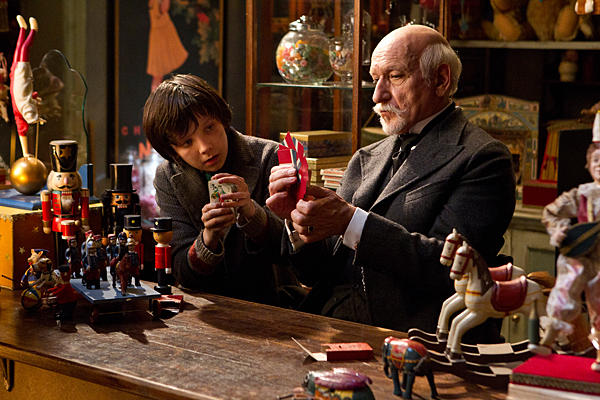
Hugo - My personal favourite of the nominated films (in fact overall it is my second favourite film of the year), this stunning Martin Scorsese homage to the birth of cinema, ironically using the most modern of technology, is a visual wonder to behold.  I cannot stop praising this motion picture, nor should I have to.   But even outside of my cinephiliac leanings (the picture just oozes film history), this picture is a designer's dream project.  From the intertwining maze of the Paris metro station to the coming to life of long lost movies to the magical essence of the story itself, the sheer beauty of the images is what one would call pure cinema.

Midnight in Paris - It is strange to see a Woody Allen film nominated for Best Art Direction.  Strange enough that this is but the fourth Allen film to nominated in this category.  Usually more of a dialogue kind of director, Allen's ode to the magic of Paris and the literary dreams of the director's youth, is still a rightful nominee.  Showing the magical world of 1920's Parisian life amongst the famed ex-pats that helped to make the city a Mecca for the arts, the shops, the cafes, the museums and cobblestone streets, this is more than mere dialogue driven cinema (though the screenplay is quite superb in its own right) and is a beauty to behold.

War Horse - I must admit to not liking much about this latest Spielberg opus.  The story is trite and cloying and some of the supposedly emotional scenes are downright ridiculous.  However, that being said, the one aspect of the film I did enjoy is the visual audacity that Spielberg throws at the screen.  The man can definitely do war better than most anyone else out there these days, and the harrowing imagery that Spielberg and his artistic team put forth are brilliant enough to, at least momentarily, make one forget about all the other shortcomings in the film.

So which film do I think will take home the Oscar?  It would seem this is pretty much a two way race between Hugo and The Artist, and I could feasibly see either film winning.  Since The Artist is most surely going to beat out Hugo for the top prize, this could be thought of as a sort of consolation prize for the Scorsese picture, but then again, if The Artist is going to sweep, which seems to be a more and more distinct possibility, then it will take it.  So to toss out an answer, I think The Artist will take home this particular prize (and I am sure, many more).

Monday, November 28, 2011

Woody & Me: Through the Years

The following is my contribution to The LAMBs in the Director's Chair #22: Woody Allen.

The first Woody Allen film I remember seeing was 1973's Sleeper.  It would have been around 1978 or 79 that I saw it on TV.  I would have been just eleven or twelve at the time, so needless to say I did not get many of the sexual or political jokes.  The Orgasmatron went right over my head (kids were more naive in those days) but I do remember liking the giant chicken.  I have of course gone back and rewatched the film, on several occasions, and now consider it to be one of Woody's best and funniest films.  

My real attraction to the films of Allen Stewart Konigsberg (the name with which he was born back in 1935 Brooklyn) came around 1984 with the purchase of my very first VCR. (remember those?)  I was seventeen and this VCR was the first major purchase I ever made with my own hard-earned money.  I also got myself a membership at a local video store called Movie Merchants and began renting movies as if I were a young man with a great obsession.  Of course this was very true, as this was the time I began to evolve into the obsessive cinephile I am today.  This was to be the birth of my lifelong desire for everything cinema.  The beginning of my obsession.  But I digress.

Among the multitudes of titles (on video cassette long before the advent of DVD and Bluray!) that I rented those first few months of membership, were several Woody Allen films.   The first among these, which should come as no surprise, was Annie Hall.  Considered the director's finest work (it makes my top twenty favourite films of all-time), and a departure from his earlier slapstick comedies, Annie Hall is what a romantic comedy should be.  Both edgy and wry, the film stars Woody as Alvy Singer, a typically neurotic writer, and Diane Keaton as his love interest, the titled gal herself, Annie Hall.  The couple had been a couple offscreen as well (they had split up several years before Annie Hall was made, and remain friends to this day) and the character is actually named after Keaton, who had been born Diane "Annie" Hall.

The greatness behind the film, other than the adorable-as-hell performance from Ms. Keaton, is the direction of Mr. Allen himself.  Influenced by Ingmar Bergman as much as Groucho Marx and Charlie Chaplin, Allen made his film as both comedy and drama.  Tossing in multiple styles, including inner monologue subtitles, breaking the fourth wall, introducing insane asides, flashbacks, split-screens and even an animated segment, Allen's Annie Hall, winner of the Best Picture Oscar in 1977 (and Best Director, Screenplay and Actress for Keaton), is what one could and should call a true masterpiece of cinema.  This was also the time period where I first saw Love and Death (influenced by Russian literature), A Midsummer Night's Sex Comedy (Shakesperean comedy as Bergman remake), Zelig (an early mockumentary), Broadway Danny Rose (showing Allen's comedic upbringing) and Bananas (an early Chaplinesque slapstick).

The three Woody Allen films I saw in this initial flurry of filmwatching that most thrilled me though (aside from the aforementioned Annie Hall) were his ode to Bergman, the serious-minded drama Interiors, his take on Fellini's 8 1/2, Stardust Memories (a film that often gets forgotten when talking of Allen's quite prolific oeuvre) and the Woodman's homage to the city he loves so much, Manhattan.  Using the music of Gershwin (how can you not love a Woody Allen soundtrack!?) and the most stunning of black and white cinematography by Gordon Willis, Allen's Manhattan makes the city itself the main character of his movie.  A city that would play the most important part in many a Woody Allen motion picture, becomes the most important aspect of Manhattan.  The following year I would rent and watch 1985's Purple Rose of Cairo.  One of Allen's most enjoyable films, and one that has grown on me more and more with each successive viewing. 

It was 1986 that Woody and I took our cinematic relationship to a whole other level.  Up until then, I had only seen Woody on the small screen, but that year, my first year out of high school, we went big.  Big screen that is.  Hannah and Her Sisters (my third favourite Woody) would be my first Allen film seen in an actual cinema.  Seen with my mom, aunt and uncle, at an AMC theater in town, the film was a blast, as they say.  The rest of the fam wasn't all that thrilled by it (they never have been big fans of the Woodman), but I quite enjoyed my first theatrical Woody Allen experience.  My cherry popping if you want to keep going with the cine-sexual relationship angle.

The following year would bring my second theatrical rendezvous with the Woodman (how's that for innuendo?).  It would be Radio Days, and unlike the majority of Allen's films, the director would not appear on camera in this one, instead acting as narrator.   Probably the most nostalgic of Allen's films, Radio Days is an ode to that romantic era of the director's childhood.   A pair of dramatic works, September in 1987 and Another Woman in 1988, would follow Radio Days.  These too would be sans Woody the actor.  These would also be two films I would not see till much later (September in the late 1990's and Another Woman for the first time just earlier this year).  Cut now to early 1989.  It has been three years since Woody starred in one of his films.  But this would soon end - in spades. 

First would come the omnibus film New York Stories.  A three part venture directed by Martin Scorsese, Francis Ford Coppola and Allen.  Scorsese's section, starring Nick Nolte as a crazed artist, is my favourite part of the film, and Coppola's part is a sentimental look at childhood in the limelight (obviously based on his daughter Sofia), but Woody's is of course the funniest.  An absurdist look at the Oedipal complex, sprightly called Oedipus Wrecks, it is the story of a man with an overbearing mother.  One day, during a magic act (Woody does love his magic), the mother vanishes, and Woody's smothered son feels free at last.  Alas, the mother comes back as a giant floating head who continues to lovingly torment her son.  Great Woody, but still just a short film.  Later that same year would bring his real (semi)comeback.

Crimes and Misdemeanors is an intriguing blend of the dramatic and the comedic.  Loosely based  on  Dostoyevsky's Crime and Punishment, Allen takes the idea of morality in murder and puts it into a very Allenesque realm.  The director would come back to these themes fifteen years later in Match Point.  After making the mostly forgotten Alice in 1990 (one of the few Allen films I have not seen), playing actor only opposite Bette Midler in Paul Mazursky's Scenes From a Mall, and directing the German Expressionist homage, Shadows and Fog (a film I would not catch on video until a few years later), the shit sort of hit the fan.  Not to play into the whole tabloid aspect of the Woody/Mia/Soon Yi relationship, it was in 1992 that the story hit the newsstands, and would taint Allen's career to this day.  I personally do not think Allen did anything illegal (immoral is a different story, but since Woody and Soon-Yi are still together today, nineteen years later...) but whether he did or not, the scandal still hangs heavy, though to a lesser degree now than then.

The film that came out in the midst of all this he said/she said nonsense was Husbands and Wives.  It would be Mia Farrow's final film with her long time lover.  It would also be Woody Allen's last truly great film for nearly two decades.  After Husbands and Wives Allen would make Manhattan Murder Mystery.  The film would star his former paramour Diane Keaton.   After this would come a succession of enjoyable but not great films.  Bullets Over Broadway in 1994, Mighty Aphrodite in 1995, Everyone Says I Love You (a musical!) in 1996, Deconstructing Harry in 1997, Celebrity in 1998 and Sweet and Lowdown in 1999.  Granted, these may not be Allen's golden age films, but they are still all quite good.  At the turn of the millennium, this would no longer be true.

In 2000 came Small Time Crooks.  A somewhat fun comedy but definitely lesser Woody Allen.  But still, the worst was yet to come.  The following year would bring the world The Curse of the Jade Scorpion.  This is possibly the director's creative low point.  Though, with followups such as Hollywood Ending, Anything Else and Melinda and Melinda, perhaps it is not.  Still though, this five year period is not an era that will be remembered fondly in future studies of the filmmaker's career.  I personally would place Anything Else at the bottom of any Woody Allen list.   But this lull would not last forever.  In 2005, Woody would change in his usual New York skyline for one of Trafalgar Square and Piccadilly Circus.  Setting his new film in London, Match Point played as not only a departure for the Manhattan-loving auteur, but also a comeback of sorts.  Critically acclaimed for the first time this millennium, Allen's new film was a welcome return to form for the director - even if it was a strange new form.  It was also the film that garnered Woody his sixteenth Screenplay Oscar nomination, untying him with Billy Wilder and giving him the record for the most nominations in the category.

Sadly though, this comeback would hit a glitch the following year when the rather horrendous Scoop was released.  Giving Anything Else a run for its money as the worst Woody Allen, Scoop was Allen's second film with his young new muse, Scarlett Johansson.  At least now the 71 year old old would be  playing the father figure instead of the romantic lead.  But luckily this glitch was as short-lived as the comeback before it, for, after the almost completely forgotten Cassandra's Dream (the other Woody I have never seen), 2008 would bring Allen's best film in over a decade, Vicky Cristina Barcelona.  Again starring the vapid Ms. Johansson, VCM would now take the traveling Allen from France to Spain.  The film would win Penelope Cruz a Best Supporting Actress Oscar - a thing that has happened to several of Allen's ladies-in-waiting.  

Next would bring another departure for Allen.  Filming a screenplay that he had written back in 1976, and originally slated to star Zero Mostel, Whatever Works, now starring Larry David, was perhaps a failure in many people's eyes, but I am one of those select few who rather enjoyed this toss-off throwback to Woody's earlier days.   Next came You Will Meet A Tall Dark Stranger, but it is rather a mediocre work and I really have nothing much to say about it, for better or for worse.  But Woody's next film would not be so mediocre.  2011 has brought us the director's finest work since the 1990's - Midnight in Paris.  Back to the City of Lights, this is easily one of the best films of the year - it could even give Woody his second Best Director Oscar.  2012 will bring us a new film, tentatively titled Nero Fiddled, starring Jesse Eisenberg, Penelope Cruz, Ellen Page, Alec Baldwin, Greta Gerwig, Roberto Begnini and Allen himself.  But that is another story for another day.

So here ends the story of my life and love affair with Woody Allen.  Well, at least here it ends until the aforementioned Nero Fiddled hits theaters next year.  I hope you had a good time reminiscing about my torrid cinematic affair with the Woodman.    

Sunday, October 30, 2011

Some Good Old-Fashioned Halloween Fun w/ Michael Myers, John Carpenter and the Scream Queen Jamie Lee Curtis

The following is my contribution to The LAMBs in the Director's Chair #21: John Carpenter.

Although both The Texas Chainsaw Massacre and the Canadian film Black Christmas precede it by four years, much claim can be staked on the proposition that John Carpenter's 1978 now-classic horror film, Halloween, was the starting point of the slasher genre that would erupt in the 1980's.  Of course Carpenter himself admits to being greatly influenced by Hitchcock's Psycho, the true sui generis of the genre, when making Halloween, so who the hell knows from whence the genre truly came.  What one does know for sure is that Carpenter's seminal slasher flick was a great, if not the greatest, influence on horror moviemaking lo these past thirty some years.  For better and for worse, Halloween gave the genre, from the giddy, gory slasher films of the eighties to the torture porn obscenities of today, its tricks and tropes and foibles and flaws.  It gave the Scream series its rulebook and Rob Zombie a career resurgence.  And then there is that creepy ass music - but more on that later.

I actually sat down to watch the original Halloween for the first time just this past week (yeah yeah, I know) and though the low body count kind of surprised me (at least in comparison to the slew of hawkish, low budget disciples that followed, Carpenter's film is quite low on violence and gore) I must admit to at least a certain amount of creeped-out narrative tension - but such a thing is Carpenter's forte after all.  The director's ability to surprise you with both what is around the corner and what is not, has always been a mainstay of his cinema - especially in his three greatest works, Assault on Precinct 13, The Thing and here in Halloween.   More than the eventual pay-off, which is by no means a slouch, it is Carpenter's knack of making us wait in heart-pounding anticipation not just to the veritable breaking point, but beyond, until we think we are safe at least for the moment, and then - BANG!!

Much like contemporaries Martin Scorsese, Brian De Palma and Steven Spielberg, as well as more recent examples such as Richard Linklater, P.T. Anderson and Quentin Tarantino, Carpenter has always been a filmmaker greatly influenced by those who came before him.  So much so that Pauline Kael even (unfairly) criticized him for such in her scathing review of Halloween, saying "Carpenter doesn't seem to have had any life outside the movies: one can trace almost every idea on the screen to directors such as Hitchcock and Brian De Palma and to the Val Lewton productions".  It is in this homage making style that Carpenter has created his interesting, if not a bit uneven, oeuvre.  To go back to his great triumvirate of the director's early years - after Assault on Precinct 13, his urban-decay take on Howard Hawks' Rio Bravo but before his graphic, paranoiac retooling of the Howard Hawks produced The Thing, came Halloween, his most Hitchcockian film, and therefore his film with the biggest, and most classically inspired BANG.  

Not only does Carpenter name the master's Psycho as his biggest influence on Halloween (along with Night of the Living Dead, which incidentally was also an influence on the aforementioned Assault on Precinct 13) but he paid homage to that film in several other ways as well.   One of these ways was the naming of Dr. Sam Loomis, the obsessed psychiatrist played by Donald Pleasence.  Sam Loomis, as any fan of Psycho can tell you, is the name of Marian Crane's lover in the film.  The most obvious homage though is the casting of Jamie Lee Curtis as the movie's final girl, Laurie Strode.   Originally Carpenter had wanted to cast Anne Lockhart, daughter of June Lockhart, but due to scheduling conflicts she could not take the part.  This particular scheduling conflict was particularly fortuitous, for when Carpenter found out that another actress interested in the part was the daughter of Janet Leigh - Marion Crane herself - he had to have her for the part.  Starring in the short-lived TV version of Operation Petticoat at the time (the original film version coincidentally starred the actress's father Tony Curtis), the nineteen year old Curtis was the perfect pick for the film.  What better homage than casting the daughter of the master's Scream Queen as his own Scream Queen?

Playing the chaste babysitter who lives, while her promiscuous friends are slaughtered (a trope that would become a cliche of the genre, as well the joke behind Wes Craven's Scream) Curtis is the terrorized victim who in turn must be saved by Pleasence's Dr. Loomis (and yes, feminists have taken note) from the man in the mask.  Of course we all know that the man in the mask is actually Michael Myers, who at the age of six brutally murdered his teenage sister, and who has, fifteen years later,  escaped from the mental hospital to come home and terrorize those oh so slutty teens of Haddonfield Illinois.  On the subject of the virgin surviving while death comes to all those who have sex, Carpenter explains, "The one girl who is the most sexually uptight just keeps stabbing this guy with a long knife. She's the most sexually frustrated. She's the one that's killed him. Not because she's a virgin but because all that sexually repressed energy starts coming out. She uses all those phallic symbols on the guy."  Simple as that.

To make the terror all the more terrifying, Carpenter used P.O.V. shots when showing Michael stalking his prey.  The opening scene, where the six year old Michael is watching his sister and her boyfriend before stabbing his sister to death post-coitus (the guy of course gets up and leaves after sex, and is thus spared the violent end), is done completely in the point of view of the psychopathic child.  The ultimate stabbing is shown through the eyes of Michael's clown costume.  These P.O.V. shots continue upon Michael's return home.  We are put into the eyes of the killer and see what he sees (again, many are critical of this - stupidly claiming it breeds violence in children) and this makes it seem all that more terrifying.   Of course the thing that makes it the scariest, in my not-so-humble opinion, is that damn music.  Second in scariness only to The Exorcist's Tubular Bells, the film's music, composed by Carpenter himself, in rare 5/4 meter, is a simple yet haunting score.  It is enough to bring chills up and down the spine of, not just this critic, but pretty much everyone out there.

In the end it is Carpenter's prowess as a filmmaker that makes Halloween work as well as it does.  Beginning with his love of cinematic origins and history, and his ability to transform that love into his own work (this obvious Hitchcocko-Hawksian even sneaks in the original Thing From Another World as he has his characters watching said film on television) and continuing with the director's bravura stance on cinema (he brashly blows away a little pig-tailed girl in Assault on Precinct 13, so what is to stop him from doing pretty much anything to anyone in any movie), Carpenter created a genre masterpiece in his original Halloween.  The film would go on to spawn seven sequels, as well as a remake and even a sequel to the remake, none of which were directed by Carpenter, and become, for better and for worse again, one of the most influential films ever made.  Carpenter himself would continue with a later career that has yet to match his output of the seventies and early eighties (his most recent, 2011's classically-influenced The Ward, is definitely a step in the right direction though) but no matter what the future brings, his legacy will surely live on and on and on.

I have written about two other John Carpenter films recently.  The first is the director's second feature, Assault on Precinct 13, published elsewhere on this blog.  The second is a review of the director's latest work, his first picture in a decade, The Ward, published over at my review site, The Cinematheque.

Tuesday, September 27, 2011

The Cool Guy Swagger of the Michael Mann Film

The following is my contribution to The LAMBs in the Director's Chair #20: Michael Mann.

Michael Mann is what one would call a mano y mano kind of director. Whether it be William Peterson's FBI profiler vs. Brian Cox' Hannibal Lektor in Manhunter or Tom Cruise's coolly psychotic killer vs. Jamie Foxx' intrepid cabbie in Collateral or Christian Bale's righteous G-man vs. Johnny Depp's charismatic Dillinger in Public Enemies or the equally iconic De Niro and Pacino going up against each other in Heat or, for that matter, Daniel Day Lewis' Hawkeye or Wil Smith's Muhammad Ali vs. just about everyone in The Last of the Mohicans and Ali respectively. Yes indeed, Mann is certainly (and the pun is very much intended) a man's man kind of director.

The director's filmic output (just ten films in thirty years) is probably the most macho since Peckinpah was drunkenly barking out directorial demands back in the 1960's and 70's, but even crazy old Sam allowed his female characters, on occasion, to become more than mere eye candy or gun moll or weepy wife to their male counterpart. The closest a Mann heroine has come to headlining, let alone being allowed to be heroic (at least heroic in the way Mann's macho men are allowed to be heroic) is Madeleine Stowe's rather thankless role in The Last of the Mohicans. And even she has to sit around and wait for her man to return as he promised he would.

Okay, perhaps some of that is a bit of an exaggeration (Stowe's Cora does more than her part as heroic figure and Marion Cotillard's Billie Frechette is tough-as-nails under brutal interrogation in Public Enemies) but there is certainly no denying that the oeuvre of Michael Mann is the manliest of places. But then again, the filmmaker is far from misogynistic in his treatment of women - he, and his films just do not have much of a need for them is all. It is the tough guy personas of James Caan and Russell Crowe and Robert De Niro and Al Pacino and Colin Farrell and Jamie Foxx that make Mann's films so appropriately manly.

Then again, Mann's films, as macho man as they want to be, are more than mere hardboiled flapdoodle. They are creature creations of visceral, visual beauty. Filmed with a cool demeanor, both in story and in design, and with a slick eye for the inherent radiance of filmic space and cinematic place, Mann's slick oeuvre is more often than not, on par or close to being on par with the works of compatriots like Scorsese and Fincher.  His film's, even those about misfits (which incidentally is nearly all of them), have that all important (at least in the case of the film's subject matters) cool guy swagger to them.  As cocksure heroes and antiheroes like John Dillinger, Muhammad Ali, Lowell Bergman, Natty Bumppo, Crockett & Tubbs, and even a character such as Hannibal Lektor, strut about in their various cool guy ways, Mann's camera seems to do the very same swagger as they.

The two Mann films that best embody this aesthetic are Collateral and Miami Vice.  To prove that I have always thought this of Mr. Mann, I give you my original reviews of both films.

First, here is my original take on Collateral (originally published Summer 2004):

There is a moment in Collateral late into the film, where Tom Cruise as the silver-haired assassin and Jamie Foxx as his unwitting cab driver escort are driving toward what will become number four in an after hours execution binge of murdered witnesses-for-the-prosecution. The scene shows the tattered taxi and its two opposing occupants being stopped by a street-crossing pair of coyotes. At this point, Director Michael Mann slows down his camera and soundtrack musical number and we watch, along with the characters in the film, these predatory canines leisurely gait their way across the boulevard. It is at this exact moment, contrary to any plotline in the film, that we see Michael Mann do what he does better than almost any other American-Hollywood Filmmaker working today. Michael Mann is a late night urban existentialist with the electric neon eyes of a hyper-active meth-junkie who has just recently embraced the teachings of the Dhammapadda. Mann, who made the stylistic crime drama Heat and the moody Sixty Minutes docu-drama The Insider has brought his visual slickness, a combination of eighties TV cop-pop eye candy Miami Vice and a Travis Bickle-induced homage toward the opening sequence of Scorsese's Taxi Driver to the adaptation of screenwriter Stuart Beattie's slim and (somewhat) shallow screenplay.

Collateral, shot mainly on high-definition digital video, gives off a certain hue that makes the LA night time appear to be almost glowing with a wet fluorescent look, making you feel as if it's four a.m. and you are half falling asleep sitting at the all-night laundromat, wishing your clothes would hurry up and dry so you can go home and collapse in a tired ball of sleep deprevation atop your unkempt bed. The star of this film is not Tom Cruise and it is not Jamie Foxx and it is not even the neoned Taoist Autuer Mann. It is the spookily-vacant streets of LA that are the stars of Collateral - streets that are given to us by the visual etheralness of Michael Mann's smooth-operater filmmaking technique. Even the close-ups of Foxx and Cruise are set in a deep focus negativity of the larger-than-life neon jungle that surrounds them. The city is always there and Mann has, at least temporarily, become its master - unleashing it in a cold callous smooth ugliness that only adds to its characters moral predicaments.  Mann does the quiet cerebral moments with the artistic flair of a street-lighted Picasso and thus Collateral entices us in with the ghostly urban mood of a philosopher's gaze. Cruise, with his steely determined eyes of indifference is perfectly cast (especially for a Michael Mann film), as the sleek silver-suited gun-for-hire Vincent, set on his assignment to kill five Mob-related witnesses in one night. Granted, through all the glitz and glitter of the shimmering skyscrapers of after hours LA, there is not one single moment of surprise in Collateral, yet in Mann's hands the films luscious looks make it work as only a Michael Mann film can.

And here is my original take on Miami Vice (published in Summer 2006):

Considering the kitsch mentality of the original TV show - that played out as if a weekly hour long fashion show-cum-music video - it comes as somewhat of a surprise that its 2006 namesake is the least frivolous of all the Summer blockbusters. Edgy and intense - two adjectives that were most-likely never used to describe the eighties TV show (although as a naive typical teenager of the day, I probably did consider it just that at the time) - this newer, meaner Miami Vice - which only really holds the slightest of resemblances to its predecessor (a quick audial glimpse of the original theme song hidden behind tracks of a hip hop nightclub remix and the closing credit cover of Phil Collins' In the Air Tonight, are pretty much the only connective tissue here, outside of the iconic names Crockett and Tubbs) - goes infinitely deeper and darker than the show ever dared to go.  This, of course, has a lot to do with director Michael Mann - who incidentally was a co-creator of the original show - and his slick directorial style (auteurial style perhaps).

Always one to try to tip mainstream movie-making on its collective ass, Mann plays with the concept of Miami Vice as some sort of genre experiment that only he - the mad macho maestro that he is - can decipher and splay out as a near-perfect lubricious blend of Hollywood glitz and independently minded virility that it is. Full of bull perhaps, but that bull is exactly the kick in the ass that an idea like Miami Vice has needed all along, and Mann is just the kind of visually spectacular bullshitter that can do it - and has done it.  Going in with a less-than full-bodied expectation for the story (the TV show was the epitome of the eighties pretty-but-dumb mindset) I came out with what I am sure was a shocked look of awe upon my face. A total surprise on every level - and isn't that what we want from a motion picture? Isn't that lack of surprise what is so wrong about most Hollywood films these days? I am rather confidant that when the end of the year rolls around I will still be proclaiming Miami Vice one of the best films of 2006. 

No more need be said.  Let us allow the Cool Guy Swagger of the Michael Mann Film to speak for itself.